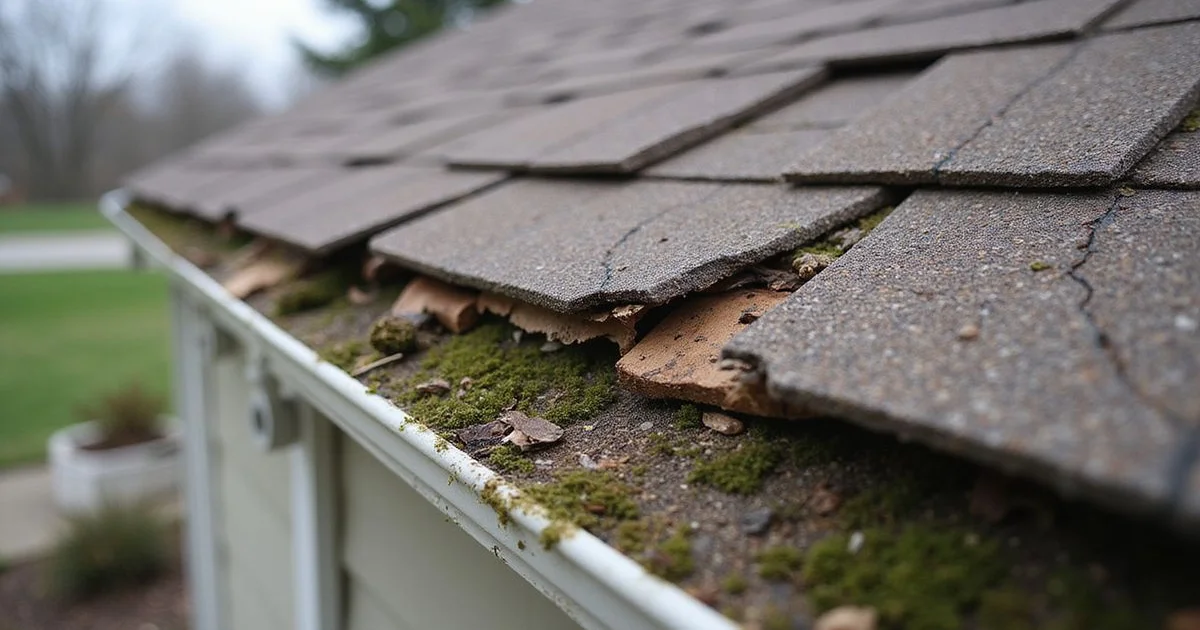
The stain on your ceiling is not where your roof is leaking. That's the first thing every Ohio homeowner needs to understand about roof leak detection. Water can travel 10 feet or more across roof sheathing, down a rafter, and through a wall cavity before it appears as a drip over your kitchen table. Finding the actual entry point requires a systematic method — not luck.
Why Roof Leaks Are Harder to Find Than You Think
Most homeowners make the same mistake: they look directly above the ceiling stain and assume that's where water is entering. In reality, gravity and building materials work together to route water on a journey that can cover surprising distances. Roof sheathing acts like a highway, channeling water laterally until it finds a low point — often a nail hole, a knot, or a gap at a rafter bay — where it drips down to the insulation below.
Ohio's climate makes leak detection even more complicated. The state's freeze-thaw cycle — sometimes occurring dozens of times in a single winter season — causes flashing metal to expand and contract until sealants crack and joints open. A flashing joint that appears perfectly sealed on a dry 60-degree afternoon may allow significant water entry during a cold, wind-driven rain. These intermittent leaks are especially frustrating because the evidence disappears before you can trace it.
Intermittent leaks (those that only show up during heavy rain or specific wind directions) are categorically different from steady leaks that appear every time it rains. A steady leak usually points to a structural gap — a missing shingle, an open pipe boot, a failed valley. An intermittent leak almost always points to a flashing problem that fails only under pressure. Understanding which type you're dealing with changes the investigation strategy entirely.
The Water Trail: Understanding How Leaks Travel Before You See Them
Before you can find a leak, you need to understand the path water takes from entry to appearance. The sequence is almost always the same: water enters at a breach in the roof surface, migrates across the underside of the roof deck (the OSB or plywood sheathing), reaches a rafter, runs down that rafter to the top plate of a wall or the ceiling joist, spreads horizontally along the joist, and finally saturates the drywall or insulation enough to drip or stain.
At each stage of this journey, the water leaves evidence. Wet or darkened wood on the underside of the roof deck shows the entry zone. A wet rafter shows the travel path. Wet or compressed insulation shows where it pooled. A damp ceiling joist shows where it spread before staining. Each piece of this trail is a data point pointing you toward the source. The detective work is tracing these data points backward, from the stain toward the ridge, until you find the breach.
One important nuance: water always travels to the lowest accessible point before dripping. If a rafter runs horizontally across a hip section, water will follow it all the way to the corner of the house before it drops. If insulation has a depression, water pools there. This means the visible stain can be far removed — sometimes in a completely different room — from the entry point above.
Step 1: Document the Interior Damage First
Before you go anywhere near the attic, spend 10 minutes documenting every piece of interior evidence. Pull out your phone and photograph every ceiling stain, every active drip point, and every area of soft or bubbling drywall. Enable timestamps on your photos or take a photo of a clock — this documentation matters for insurance claims.
Measure where each stain sits relative to the nearest two walls. Write it down. “Stain is 6 feet from the north wall and 4 feet from the east wall” gives you a coordinate you can cross-reference in the attic. If you have stains in multiple rooms, map them all. Multiple stains in a line can indicate a single long water travel path. Stains in separate areas may indicate multiple independent entry points — a critical distinction for repair scope and cost.
Note the shape and color of each stain. A fresh, active leak produces a dark, wet ring. An old leak produces a lighter brown ring with a distinct outer edge. Multiple rings inside each other indicate a leak that has been active, dried, and returned multiple times. All of this tells your contractor and your insurance adjuster something important about the timeline and severity of the damage.
Step 2: Head Into the Attic — Your Primary Detection Zone
The attic is where most leaks become visible before they reach your living space. If at all possible, make your attic inspection during rain or immediately after. Water trails on wood dry surprisingly quickly — within a few hours in a well-ventilated attic — so timing matters.
Enter the attic with a bright flashlight or headlamp, wearing a dust mask and gloves. Move carefully, stepping only on joists — never on the insulation between them, which conceals the fragile drywall below. Bring your room measurements with you so you can locate the area above each ceiling stain.
What to look for: active dripping water is the most obvious sign, but you may not catch it mid-rain. Instead, look for these indicators of recent moisture: shiny wet spots on the underside of the roof deck, dark staining on wood (which appears as black or gray discoloration against the lighter wood), compressed or discolored insulation, and rust stains around nail shanks protruding through the deck. Any of these is a starting point for tracing the water path uphill toward the entry point.
Safety note: never enter an attic if you see any electrical wiring that appears wet or discolored, or if there is any sign of structural sagging in the roof framing above you. Both situations require a professional immediately.
Step 3: Trace the Water Path Uphill From Where You Find It
Once you've located moisture in the attic — whether it's a wet spot, a stained rafter, or compressed insulation — resist the temptation to look directly above that point. The entry is almost certainly uphill from where you're standing.
Start at the moisture and follow it toward the peak. Run your hand along the rafters in the uphill direction, feeling for dampness. Shine your flashlight along the underside of the roof deck, looking for the telltale sheen of wet wood or the dark stain of dried water. If you're in a shallow-pitch attic where you can't stand upright, use a mirror and flashlight combination to see uphill from a lower position.
Water will pool and run along any horizontal member it encounters. If you find a wet rafter, follow it uphill to where it meets the ridge board or a horizontal collar tie. Check the underside of any horizontal framing members — water running along them can drip at any point, creating a false “source” that is actually mid-path. The true entry point is always at a penetration, seam, or gap in the roof surface itself — not at a framing member.
Step 4: Check the 9 Most Likely Entry Points
Once you've traced the water path to its general origin zone, inspect every roof penetration and seam in that area. In Ohio homes, leaks almost always originate at one of these nine locations:
- Failed pipe boot flashings. The rubber boot that seals the base of every plumbing vent pipe through the roof degrades over time. When it cracks or separates, it creates an open channel for water to run down the pipe and onto the deck. This is statistically the single most common source of roof leaks in residential homes.
- Lifted or rusted chimney flashing. Step flashing and counter flashing around a chimney are exposed to enormous thermal stress. When the metal corrodes or the sealant at the counter flashing seam fails, water enters behind the flashing and runs straight down the chimney's exterior wall into the attic below.
- Cracked valley flashing. The valley where two roof planes meet concentrates more water flow per square foot than any other part of the roof. If the metal valley flashing develops a crack or the woven shingle valley separates, that high water-volume zone becomes a funnel for leaks into the attic.
- Missing or damaged shingles. Wind, impact, or age can remove or crack individual shingles, exposing the underlayment or decking beneath. This is the most visible type of damage and the easiest to identify from the ground with binoculars.
- Skylight seal failure. The perimeter seal around a skylight frame is one of the most maintenance-intensive components on any roof. Both the interior gasket and the exterior counter flashing must be intact. When either fails, water enters at the frame and can travel a significant distance before appearing on the ceiling below.
- Ice dam water intrusion at eaves. Ohio winters regularly produce the temperature conditions for ice dams — snow melts on the warm upper roof, runs to the cold eave overhang, and refreezes. The growing ice dam forces water backward under the first few courses of shingles and through the underlayment into the attic. This is why leak-proof ice and water shield membrane is required by Ohio code at all eaves.
- Nail pops pushing through the underlayment. Over time, roof nails can back out of the decking due to thermal cycling. When a nail pop pushes through the shingle above it, it creates a pinhole entry point that is nearly invisible from the exterior but allows water to wick along the nail shank into the deck.
- Ridge vent seal failure. A continuous ridge vent runs the length of the roof peak and is covered by cap shingles. If the cap shingles lift, crack, or are improperly installed over the vent, wind-driven rain can enter at the highest and most central point of the roof — making the resulting leak appear anywhere below.
- Soffit or fascia gaps allowing wind-driven rain entry. During high-wind events, rain can be driven horizontally under soffit overhangs and through gaps in the fascia board or soffit panel joints. This type of intrusion often appears as a leak only during storms with strong directional wind, which is a diagnostic clue that the entry is at the eave level rather than the field of the roof.
Step 5: The Water Test (Only If Safe and Dry Conditions Allow)
If attic inspection doesn't conclusively identify the entry point — common with intermittent or very slow leaks — a controlled water test is the next step. This requires two people: one on the ground with a garden hose, one in the attic with a flashlight and a way to communicate (a phone call works well).
The critical rule of the water test: start at the lowest point and work upward. Begin by wetting the area just above the eave closest to the interior stain. Wet that area steadily for five full minutes before moving up. If your attic observer sees water enter, you've identified the zone. If not, move the hose one section uphill and repeat. Continue this methodical uphill progression until your observer reports water entry.
The reason for starting low and moving up is important: if you start at the ridge and water appears inside, you've only confirmed that the leak is somewhere below the ridge — which is not useful. Starting low and moving up gives you a precise zone when water appears.
Safety rules for the water test: Never conduct this test on a wet roof, a frosted roof, or a roof with any moss or algae growth. The only safe surface is a dry, clean roof. Never attempt this on a steep-pitch roof (anything above 6:12 pitch). If you are not completely comfortable on the roof surface, do not attempt this — hire a contractor to perform a professional water test instead.
Step 6: Identify and Document the Exact Entry Point
Once you've narrowed the leak zone, the final step is identifying the precise entry point — the specific nail, gap, crack, or failed seal that is allowing water in. This is where the investigation transitions from detection to diagnosis.
From the attic, look at the underside of the roof deck in the identified zone with your brightest flashlight. The entry point often appears as a small dark stain radiating from a single nail, a crack in the decking, or the base of a penetration. From the exterior (only if safe to access), look for the visual signatures of each of the nine entry point types described above: lifted flashing edges, cracked caulk at pipe boots, exposed black underlayment where granules are missing, or nail heads visible above the shingle surface.
Document everything with photographs from multiple angles before any repair work is done. Your photos should show the overall context (what part of the roof this is), the specific defect, and the interior damage it has caused. This three-part photo record — entry point, defect detail, interior damage — is exactly what both your roofing contractor and your insurance adjuster need to process the claim and plan the repair efficiently.
What Makes Ohio Roof Leaks Different From Other Climates
Ohio's position in the Great Lakes weather corridor gives it a climate that is unusually hard on roofing systems. The combination of factors that define Ohio weather creates failure modes that homeowners in milder climates simply don't encounter.
Freeze-thaw flashing movement is the dominant Ohio-specific cause of leak development. Metal flashings expand when warm and contract when cold. In Ohio, this cycle can repeat 30 or more times in a single winter. Each cycle stresses the sealant at every flashing joint. Over three to five years, even well-installed sealant fatigue-cracks and separates. This is why Ohio homes need flashing inspections every two to three years — far more frequently than the national recommendation of every five years.
Ice dam water intrusion at eaves is a uniquely northern problem, and Ohio sits squarely in the ice dam risk zone. When attic insulation is insufficient or attic ventilation is poor, heat escaping from the living space warms the roof deck above and melts snow. That snowmelt runs to the cold eave overhang, where it refreezes as ice. As the ice dam grows, it backs up liquid water under the first courses of shingles — exactly the zone where standard underlayment ends and ice dam protection is required.
Wind-driven rain at gable ends is another Ohio-specific vulnerability. The state's flat topography in the west and open valleys in the east funnel wind in ways that create high-pressure horizontal rain events. Gable-end rakes — the exposed edges of a roof at each end — are particularly vulnerable. If the drip edge is improperly installed or missing at the rake, horizontal rain drives directly under the first course of shingles and into the wall below.
Humidity and summer heat causing shingle cracking round out the Ohio roof stress picture. The state's humid summers put shingles through repeated wet-dry cycles in addition to thermal cycles. Shingles absorb moisture, swell slightly, then dry and contract. Over time, this causes the asphalt to become brittle and develop hairline surface cracks — especially on south-facing slopes that receive the most direct sun. These micro-cracks rarely cause visible damage from the ground but create capillary pathways for water entry that defy easy detection.
Temporary Emergency Measures While You Wait for a Contractor
If your roof is actively leaking and a contractor cannot respond immediately, there are safe and effective temporary measures to minimize damage while you wait.
Contain the water inside the home first. Place buckets under active drip points. Use old towels to absorb water near walls, where it can wick into wall cavities if it pools on the floor. Move furniture, rugs, and electronics away from the affected area. The goal is to prevent secondary water damage while the roof is being addressed.
Place a tarp in the attic over the wet area. If you can safely access the attic, positioning a plastic tarp over the wet insulation can redirect water to the tarp and slow the saturation of the insulation and ceiling below. Do not staple or nail the tarp to any structural member — simply drape it over the insulation with the edges extending past the wet zone. This does not stop the leak, but it slows the progression of interior damage significantly.
Consider a small relief hole for severe active drips. If water is actively bulging a ceiling and you can see the drywall bowing downward, the collected water is about to break through — potentially spreading across a much wider area. Use a small drill bit or screwdriver to create a single relief hole at the lowest point of the bulge, placing a bucket directly beneath it. Directing the flow to one controlled point prevents a catastrophic drywall failure that damages a much larger area.
Under no circumstances should you climb onto a wet, icy, or snow-covered roof for any purpose, including tarping. This is one of the leading causes of serious roofing-related injuries. Call 877-367-1885 for Fairfield Peak Roofing emergency service — we respond to active leak emergencies throughout Fairfield County.
When DIY Leak Detection Becomes Dangerous
The attic inspection and documentation steps described in this guide are safe for most homeowners. But there are specific conditions under which you should stop the investigation and call a professional immediately, without further interior or exterior exploration.
Electrical near water. If any ceiling light fixture, junction box, smoke detector, or visible wiring is near the wet area, do not touch anything. Water and electricity are a lethal combination. Turn off the circuit breaker for the affected room if you can do so safely without touching wet surfaces, and call both an electrician and a roofer.
Structural sagging. If the ceiling is visibly sagging, or if the roof deck above appears to be deflecting downward when viewed from the attic, the structural integrity of the system may be compromised. Exit the attic and do not re-enter. Call a contractor immediately and do not allow anyone into rooms below the sagging area.
Mold. If you see black, green, or white fuzzy growth on the attic framing or insulation, you have an active mold problem that requires professional remediation — not just roof repair. Mold in the attic indicates that the roof has been leaking long enough for biological growth to establish. Disturbing mold colonies without proper containment can spread spores throughout the home.
Steep roofs. Any roof with a pitch greater than 6:12 (rising 6 inches for every horizontal foot) is a steep-pitch roof. Walking on a steep roof without proper fall protection equipment is genuinely dangerous. Do not attempt exterior inspection or water testing on a steep roof. All work above the eave line should be performed by a contractor with harness and anchor equipment.
What to Tell Your Roofer (And Your Insurance Company)
The documentation you've gathered through this process — interior photos with measurements and timestamps, attic photos showing the moisture trail, exterior photos of suspected entry points — gives your contractor a significant head start on the diagnosis. When you call, be prepared to describe: which rooms are affected, when you first noticed the leak, whether the leak is steady or intermittent, and what weather conditions produce the leak (all rain, heavy rain only, specific wind direction). This information helps narrow the source type before the contractor even gets on the roof.
For your insurance company, the documentation serves a different but equally important purpose. Most Ohio homeowners' policies cover sudden and accidental roof damage — storm damage, wind damage, fallen objects — but exclude gradual deterioration and maintenance failures. Your timestamped photos demonstrating that this is a new problem, combined with weather data showing when the storm or weather event occurred, form the foundation of a successful claim. For a detailed walkthrough of the claims process, see our guide on how to file a roof insurance claim in Ohio.
If your inspection reveals significant damage beyond the leak — widespread flashing failure, damaged decking, or multiple entry points — the appropriate response may be a full roof repair assessment rather than a single-point fix. A licensed contractor can tell you whether the damage is isolated or indicative of a system that is approaching end of life. Getting that answer early gives you time to plan and budget rather than reacting to the next emergency.
Need Help with Your Roof?
Get an inspection and estimate from Lancaster's most trusted roofing team.