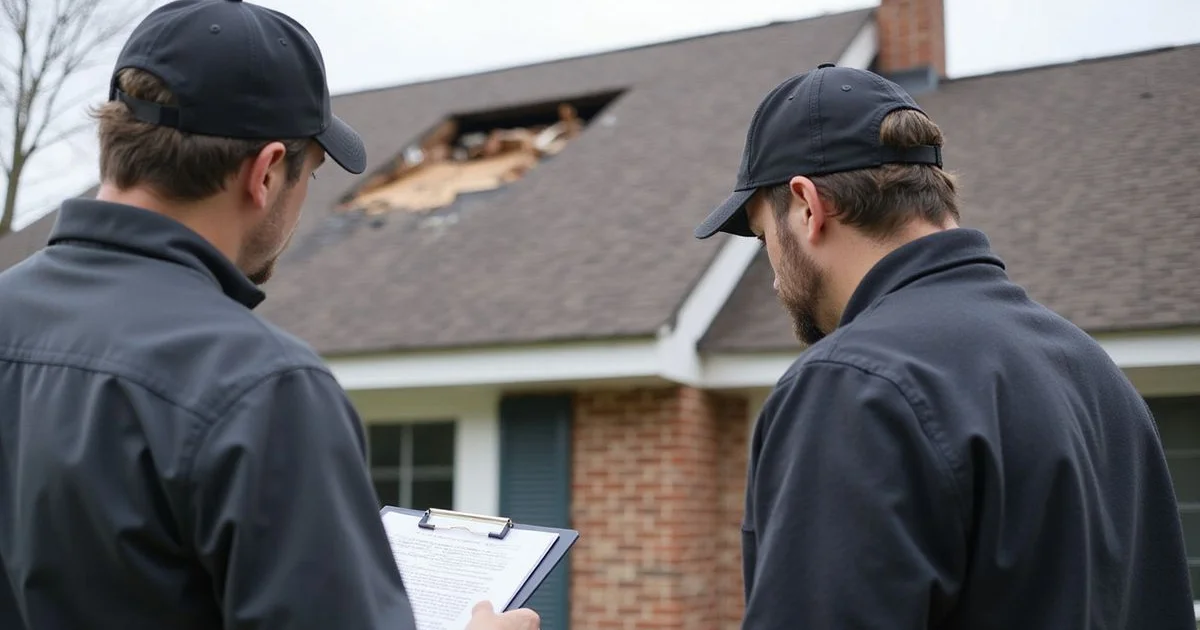
Ohio's spring storm season runs March through June and delivers some of the most concentrated hail activity in the Midwest. A single severe cell can drop golf ball-sized hail across entire neighborhoods in minutes, leaving damage that won't show up as a leak for weeks or months.
This guide walks you through exactly what to look for after a storm — from the safe ground-level indicators any homeowner can check to the professional inspection steps that protect your insurance claim and your roof's long-term performance.
Why Ohio Spring Hail Is Uniquely Destructive
Ohio sits in a secondary hail alley — the Ohio Valley convergence zone where warm Gulf air collides with Canadian cold fronts. This atmospheric collision creates powerful supercell thunderstorms that are among the most productive hail-generating systems in North America.
NOAA logged hail on about 2 days a year in Fairfield and Licking counties and about 1 day a year in Pickaway County from 2000 to 2025. In Fairfield County, 87% of hail days fell between April and July.
Hail damage is insidious: shingles can look fully intact from the ground while the fiberglass mat underneath is fractured and compromised. A homeowner with no visible leaks in spring may discover significant interior water damage by the following January when freeze-thaw cycles exploit the weakened mat.
Granule loss from hail accelerates UV degradation at an accelerated rate. A shingle that loses even 20% of its protective granule layer in a May hail event becomes measurably more susceptible to thermal cracking and moisture infiltration heading into winter. The damage clock starts immediately, even when the roof appears functional.
Hail Size Reference Guide
Not all hail causes the same level of damage. The size, density, and angle of impact all affect the outcome — but size is the most reliable single predictor of damage severity. Use this reference when reviewing storm reports or communicating with your insurance adjuster.
| Hail Size | Diameter | Comparison | Likely Roof Impact |
|---|---|---|---|
| Pea hail | ¼ inch | Pea | Surface scuffing, minimal damage |
| Marble hail | ½ inch | Marble | Granule loss begins, soft metal dimpling |
| Dime/nickel | ¾–⅞ inch | Coin | Significant granule loss, mat bruising |
| Quarter hail | 1 inch | Quarter | Mat fracturing, gutter damage |
| Golf ball | 1¾ inch | Golf ball | Shingle penetration, structural deck damage |
| Baseball | 2¾ inch | Baseball | Catastrophic damage, decking penetration |
Safe Ground-Level Assessment: 6 Steps
Never attempt to walk a pitched or wet roof to assess storm damage — the risk of a fall is real and the liability falls entirely on you. Everything on this list can be assessed safely from the ground or from a ladder at the eave level. These six steps build a documented picture of what hit your home and give you concrete evidence before the insurance adjuster arrives.
Step 1 — Check soft metal first. Inspect gutters, downspouts, AC unit fins, flashing, and your garage door panels. Circular dents on soft aluminum are definitive proof of hail impact — if metal is dimpled, your shingles were hit by the same storm. This is one of the most compelling forms of evidence because metal records every impact with precision that shingles don't.
Step 2 — Scan the ridge line. Stand back from the house at a distance and look at the ridge. Missing or shifted ridge cap shingles are a clear sign of wind damage alongside hail. Ridge caps take the highest wind load on any roof and are frequently the first component displaced in a severe event.
Step 3 — Inspect window screens and sills. Hail impact leaves a characteristic pattern of small circular punctures in window screens and chips in aluminum window trim. Document these with close-up photos from multiple angles — they provide corroborating evidence of impact energy that adjusters find highly credible.
Step 4 — Check the downspout output. After the storm passes, rinse your downspouts with a garden hose or wait for rain and collect what washes out. Heavy granule discharge — a substantial amount of dark gray grit — after a storm event indicates significant surface loss from the shingles above. Normal wear produces some granule shedding, but post-storm discharge is noticeably heavier.
Step 5 — Document with dated photos. Before touching or moving anything, photograph all visible damage using your smartphone. The timestamp embeds automatically in the image EXIF metadata. Insurance adjusters can use this EXIF data to confirm damage occurred during the specific storm event rather than from prior wear. Photograph damage on all four sides of the structure, including any vehicles or outdoor furniture that also took impacts.
Step 6 — Call a licensed Ohio contractor for the roof surface. Do NOT attempt to walk a sloped roof after a storm, even if it appears dry. A licensed contractor inspection finds mat fractures, lifted flashings, and pipe boot damage that are completely invisible from the ground. This professional assessment also creates a written record that strengthens your insurance claim before the adjuster's visit.
What Hail Damage Actually Looks Like on Shingles
Understanding the visual signatures of legitimate hail damage helps you evaluate a contractor's assessment and protects you from both under-reported and inflated claims. Hail creates "bruises" — areas where the fiberglass mat is fractured beneath intact-looking surface granules.
When a trained inspector presses on a hail-damaged shingle, it feels soft or spongy rather than firm and rigid. The fiberglass mat has lost its structural integrity at the impact point, and that loss is permanent — the shingle will not recover. Granule displacement at the impact site leaves bare spots visible as dark gray or black areas against the surrounding shingle color.
Legitimate hail damage has a random, scattered distribution across the shingle field — because hail falls at an angle and impacts wherever it lands. Storm chasers and less ethical contractors sometimes point to normal manufacturer dimples or factory defects as "hail damage." The distinction is reliable: legitimate hail damage is random and irregularly shaped, manufacturer dimples are uniform, symmetrical, and consistently spaced across all shingles of the same batch.
Hail damage on 3-tab shingles is easier to identify visually than on architectural (dimensional) shingles, because the irregular surface texture of architectural shingles can partially obscure impact marks. If you have architectural shingles, a professional inspection with an experienced eye is even more important — adjuster-level identification requires knowing exactly what to look for.
Wind Damage Signs to Check
Most Ohio severe storms produce wind damage alongside hail, and both damage types are typically covered under the same homeowner's insurance claim. Wind damage has its own distinct signatures that differ from hail impact.
Look for lifted or missing shingle tabs, particularly along eave edges and rake edges — the highest wind stress points on any roof. Wind damage frequently begins at the corners and perimeter of the roof where negative pressure zones develop during a storm. Curled or buckled shingles mid-field indicate seal strip failure from high wind.
Exposed decking visible in gaps between shingles indicates material loss, not just lifting. The ridge cap is frequently the first component to blow off, since it sits at the highest point of wind exposure. Ohio's building code requires shingles rated for 90 mph wind resistance; most Ohio storms don't exceed this threshold, but tornadoes and straight-line wind events can generate far higher localized speeds that compromise even code-compliant installations.
Ohio Insurance Claim Process After Hail
Ohio's homeowner insurance framework provides strong consumer protections for storm damage claims — but only if you act within the required timelines and follow the correct sequence of steps. Understanding the process before you need it is the most valuable preparation you can make.
Ohio HO policies cover storm damage but require you to file within the policy's reporting window — typically 1–2 years from the event, though your specific policy language controls. Do not assume you have unlimited time. Under ORC 3901.832, Ohio requires insurers to acknowledge your claim within 10 business days and to resolve it or provide a written explanation within 21 business days of receipt of a properly executed proof of loss.
Follow this sequence: (1) File your claim immediately after discovering damage — don't wait for contractor estimates. (2) Get a licensed contractor inspection before the adjuster's visit so you have an independent written assessment to present. (3) Request a written itemized estimate from your contractor specifying materials, quantities per square, and unit pricing. (4) Never sign an Assignment of Benefits (AOB) or "direction to pay" agreement that transfers your claim rights to a contractor — these documents surrender your control over the settlement process.
If you receive a settlement offer that appears to undervalue the damage, you have the right to hire a licensed public adjuster to represent your interests or to invoke the appraisal process under your policy. The appraisal process involves each party selecting a neutral appraiser, and any resulting award is binding. This mechanism exists specifically to resolve disputes between homeowners and insurers without litigation.
Repair vs. Replacement After Storm Damage
The threshold question after any significant hail event is whether the damage warrants repair of specific areas or full replacement. Several objective criteria drive this decision — and your contractor's written estimate should reflect each of them explicitly.
If hail has damaged 25–30% or more of your roof surface area, most insurers will approve full replacement rather than repair. The economic logic is straightforward: patching a heavily damaged roof with mismatched materials reduces performance without solving the underlying issue. The industry standard "10% rule" provides another threshold: if more than 10% of shingles within a given square (100 square feet) show qualifying damage, that entire square typically qualifies for replacement in most policy frameworks.
Mixed-age roofs — repaired sections alongside original shingles from a prior installation — create matching problems that can affect both function and home value. Color fading means new shingles rarely match the surrounding field, and the visual disparity is immediately apparent from the street. Ask your contractor for a per-square damage count in their written estimate — this is the same metric insurance adjusters use to determine repair vs. replacement eligibility, and having it in writing ensures you and the adjuster are working from the same documented baseline.
Frequently Asked Questions
How soon after a storm should I get my roof inspected in Ohio?
Within 2–4 weeks of the event. Most Ohio homeowners policies have a 1–2 year claim window, but filing promptly strengthens your claim by linking damage to a specific storm event. The Storm Prediction Center (SPC) maintains storm event records by date and location that can confirm a qualifying event occurred — useful if your insurer questions the timing.
What size hail causes insurance-qualifying damage to asphalt shingles?
Hail ¾ inch (nickel size) and larger consistently causes qualifying damage to standard 3-tab and architectural shingles. Hail under ½ inch may cause cosmetic granule loss but typically doesn't penetrate to the fiberglass mat. Independent testing by IBHS (Insurance Institute for Business and Home Safety) uses ¾-inch hail as the damage threshold in most standard test protocols.
Can I file a hail damage claim on a roof more than 1 year old?
Yes, unless your policy contains a specific aging or cosmetic damage exclusion clause. Under an ACV (actual cash value) policy, depreciation is subtracted from your payout based on the roof's age and condition at the time of loss. Under an RCV (replacement cost value) policy, you receive the full cost to replace with like materials regardless of age. Most Ohio homeowners carry RCV coverage — verify by checking your policy's declarations page for the coverage type designation.
Will a hail damage claim raise my Ohio homeowners insurance premium?
A single weather-related claim typically does not raise your premium in Ohio because weather events are classified as "no-fault" claims — the loss was not caused by any act or omission of the homeowner. However, multiple claims within a 3–5 year period may trigger a surcharge review or non-renewal notice from some carriers. Always verify with your agent before filing small claims where the payout may be near or below your deductible.
What's the difference between wind damage and hail damage on a roof?
Wind damage presents as lifted, buckled, or missing shingles — particularly along eave edges, rake edges, and ridges where aerodynamic forces are most concentrated. Hail damage presents as random circular impact bruises or bare spots distributed across the field of shingle surfaces, with no directional pattern. Most Ohio severe storm events produce both damage types simultaneously, and both are typically covered under the same claim.
How do I tell if a roofing contractor is storm chasing for hail work?
Legitimate local contractors are verifiable through the Ohio Secretary of State business search and have Google reviews spanning multiple years with named local projects. Storm chasers typically arrive door-to-door within 24–48 hours of an event, operate from P.O. box addresses with no verifiable Ohio presence, and apply immediate signature pressure. Under ORC 3901.78, any contractor who offers to waive or absorb your insurance deductible is committing insurance fraud — walk away and report them to the Ohio Department of Insurance at insurance.ohio.gov.
Worried About Hail Damage on Your Roof?
Get a professional storm damage inspection from Lancaster's most trusted roofing team before the insurance adjuster visits.