When water starts staining your ceiling in Lancaster, the first question isn’t “how bad is the damage?” It’s “do I need a repair or a full replacement?” — and the answer determines whether you spend $800 or $18,000. Getting this decision wrong in either direction is costly.
Why This Decision Matters More Than Most Homeowners Realize
Repair and replacement are not interchangeable options that simply differ by price. A repair buys time; a replacement buys a new roof with a fresh warranty, updated ice and water barrier, and a clean inspection record.
Both have their place in a smart homeowner’s strategy. The costly mistake isn’t choosing one over the other — it’s choosing the wrong one. Pouring $4,000 into repairs on a 23-year-old roof delays an inevitable $14,000 replacement by at most a couple of years and often accelerates it by creating a patchwork system that leaks in new places.
Equally, replacing a structurally sound eight-year-old roof because of isolated flashing damage wastes a decade of remaining service life and $12,000 or more that a $400 repair could have addressed. The goal of this guide is to give you the specific data points that make this decision obvious rather than a guess.
The True Cost of Roof Repair in Ohio (2026)
Most homeowners dramatically underestimate what repairs cost at the higher end and overestimate what they buy at the lower end. Here is where Ohio roofing contractors are pricing common repairs in 2026.
| Repair Type | Typical Ohio Cost | When It Makes Sense |
|---|---|---|
| Shingle patch (1–5 shingles) | $300–$600 | Isolated storm damage, roof under 15 yrs |
| Flashing repair | $200–$500 | Leak at chimney/vent, flashing lifted or rusted |
| Pipe boot replacement | $150–$350 | Cracked rubber boot causing attic leak |
| Valley repair | $500–$1,500 | Damaged valley flashing, localized granule loss |
| Partial section replacement (100–200 sq ft) | $1,500–$4,000 | One slope damaged, rest of roof in good shape |
One number that surprises homeowners: a basic service call and inspection from a licensed roofer in Ohio runs $150 to $300 before any work begins. That cost is almost always worth it, because a written inspection report gives you leverage with your insurance adjuster and a clear baseline for comparing contractor bids.
The True Cost of Roof Replacement in Ohio (2026)
A standard asphalt shingle roof replacement on an average-size Ohio home (1,500–2,200 square feet of living space, typically 20–28 squares of roofing) runs $8,500 to $15,000 in 2026. Larger homes or steeper pitches push that to $18,000 or higher.
Metal roofing — standing seam or exposed fastener panels — starts around $18,000 and climbs to $35,000 for a full replacement on a typical Ohio home. The premium is real, but so is the return: a properly installed metal roof in Ohio carries a 40–70 year lifespan and dramatically outperforms asphalt in ice dam resistance.
Slate and premium synthetic slate run $25,000 to $60,000 depending on the material and scope. Natural slate installed correctly will outlast the house; the cost reflects both material and the specialized labor required to set it.
Four factors drive costs up beyond base material pricing. Steep pitch adds 20–40% to labor costs because crews work slower and need additional safety equipment. Roof size measured in squares (one square equals 100 square feet) is the single biggest driver of total cost. Multiple tear-off layers — Ohio code limits you to two layers of asphalt before full tear-off is required — add $500 to $1,500 in disposal costs. Decking damage found during tear-off adds $3 to $7 per square foot of replacement, and it’s common on roofs over 20 years old with a history of moisture intrusion.
The 50% Rule: When Repair No Longer Makes Financial Sense
The roofing industry uses a straightforward benchmark: if the cost of a repair exceeds 50% of what a full replacement would cost, you should replace the roof. The logic is simple — you are spending half the money on a system that will still fail within a few years.
Age amplifies this rule significantly. Consider a homeowner with a 22-year-old asphalt roof who receives a $3,000 repair estimate against a $14,000 replacement quote. At face value, $3,000 is well under the 50% threshold of $7,000. But at 22 years in Ohio’s climate, that roof is operating in borrowed time regardless of the repair outcome. The $3,000 buys a best-case extension of two to three years before another failure point emerges — which tips the true cost well over the 50% mark when you account for the repair plus the near-term replacement.
The rule works cleanly when the roof is under 15 years old. A $2,500 repair on a 10-year-old roof with a $12,000 replacement cost is a clear repair candidate: you are buying 10 or more additional years of service life at 20 cents on the dollar. Age is the multiplier that changes which side of the equation you land on.
5 Situations Where Repair Is the Smart Choice
Not every roof problem is a replacement trigger. Here are the five clearest scenarios where targeted repair delivers the best return on your roofing dollar.
1. Roof under 10 years old. A relatively new roof with isolated damage — whether from a fallen branch, hail strike, or installation defect — has years of remaining service life. Repair extends that life without sacrificing it. Get the repair done with matching materials and keep records for future insurance claims.
2. Isolated storm damage to one area. If a severe storm lifted or cracked shingles on one section of a structurally sound roof, and the rest of the roof shows no granule loss, curling, or cracking, a targeted section repair or replacement of that slope is entirely appropriate. Document the damage before calling your insurance company.
3. Single failed flashing point. Most roof leaks originate at flashing — the metal transitions around chimneys, skylights, vents, and valleys. A single failed flashing joint on an otherwise sound roof is a repair, not a replacement. A skilled roofer can re-seal or replace that flashing in a few hours at a fraction of replacement cost.
4. Leak traced to a pipe boot or skylight seal. Rubber pipe boots crack and shrink as they age, and skylight perimeter seals degrade from UV exposure. Both are discrete, low-cost repairs that eliminate the leak entirely when properly addressed. These are among the most cost-effective repairs in residential roofing.
5. Pre-sale cosmetic fix on a structurally sound roof. If you are preparing a home for sale and the roof is in structurally sound condition but has a small number of lifted or missing shingles that would flag on a buyer’s inspection, a targeted repair improves curb appeal and passes inspection without the cost of a full replacement that a buyer may not value dollar-for-dollar in their offer anyway.
5 Situations Where Replacement Is the Only Option
There are clear situations where repair is a financial trap and replacement is the only path that makes sense. Recognizing them early saves you the cost of a repair that simply delays the inevitable.
1. Roof over 20 years old in Ohio’s climate. Ohio’s freeze-thaw cycles, ice dams, and summer humidity combine to shorten asphalt shingle lifespan significantly compared to southern states. A roof that has reached 20 years in Lancaster or the surrounding Fairfield County area is statistically near end of life even if it hasn’t failed visibly yet. Invest in a replacement rather than a repair.
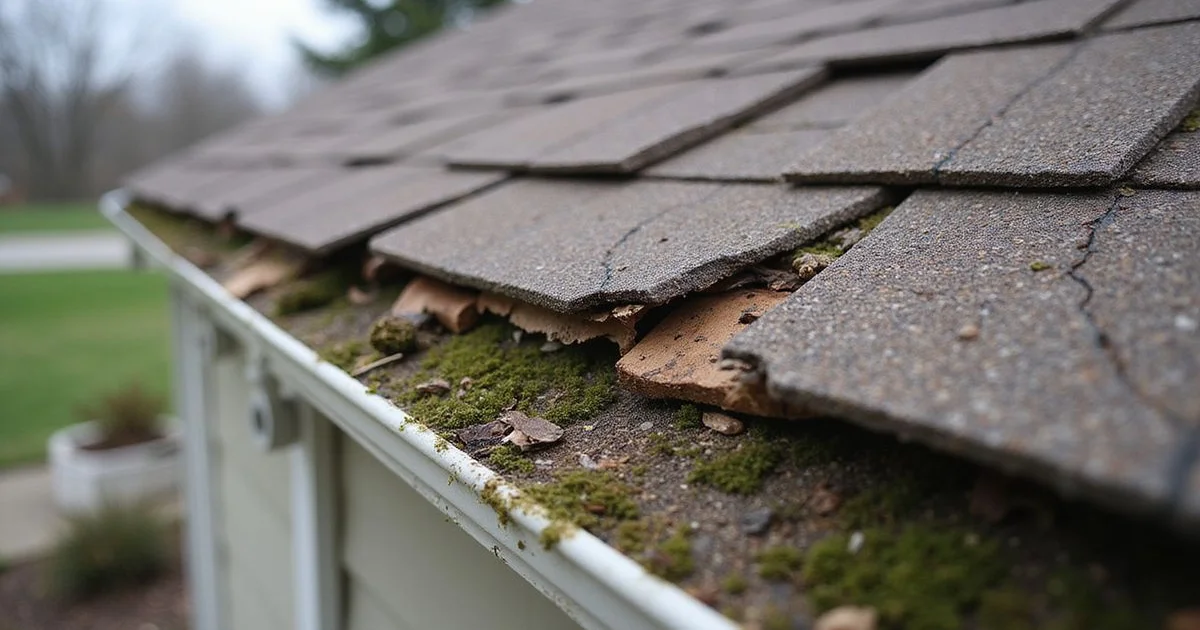
2. Sagging or soft decking. If your contractor steps on the roof and reports soft spots, or if you can see visible sagging from the ground or the attic, the structural decking beneath the shingles has been compromised by long-term moisture intrusion. No shingle repair addresses this — the deck must be replaced, which means the roof is coming off anyway. Replace the whole system while the tear-off cost is already absorbed.
3. Multiple simultaneous leak points. A single leak is a repair candidate. Two or more unrelated active leak points — one at a valley, one at a pipe boot, one at the ridge — indicate a roof that is failing systemically rather than at an isolated point. Patching individual failures on a systemically degraded roof is expensive and temporary.
4. Repair cost exceeds 50% of replacement cost. Apply the 50% rule without exception once the estimate comes in. Contractors who consistently propose repairs at 60, 70, or 80% of replacement cost are either mispricing the repair or selling you a short-term fix that benefits their service revenue more than your long-term budget.
5. Insurance total loss determination. When your insurance adjuster determines that storm damage constitutes a total loss — meaning the cost to restore the roof to pre-loss condition equals or exceeds its actual cash value — you are entitled to a replacement under most Ohio policies. Do not accept a repair settlement on a total loss determination; understand your policy and your rights.
Age Is the Most Reliable Indicator
Of all the variables in the repair versus replacement decision, roof age is the single most reliable predictor of whether a repair will hold or simply postpone the next problem. This is especially true in Ohio, where the climate puts roofing systems through a stress cycle that few other regions match.
Ohio experiences an average of 40 to 60 freeze-thaw cycles per year in most counties, meaning water infiltrates microscopic cracks in shingles and flashing, freezes overnight, expands, and forces those cracks wider. By spring, a shingle that looked fine in October may be lifting or cracking at the edges.
Granule loss accelerates with age. The granules embedded in asphalt shingles protect the underlying mat from UV degradation. As they wash off into gutters — which you can check yourself by running your hand along the bottom of a downspout — the asphalt mat beneath them absorbs UV radiation and dries out, becoming brittle and prone to cracking. A roof losing granules heavily is months or a few years from active failure, not a decade.
Ohio’s summer humidity also plays a role that homeowners underestimate. Poorly ventilated attics trap heat and moisture against the underside of the decking, which accelerates adhesive breakdown on self-sealing shingle strips and promotes mold growth in the decking itself. Age compounds every one of these factors simultaneously, which is why a 20-year-old Ohio roof behaves more like a 25-year-old roof in the Mid-Atlantic states.
What Your Insurance Covers: Repair vs. Replacement Rules
Ohio homeowners insurance covers sudden, accidental damage from named perils — wind, hail, falling trees, ice dams — whether the result is a repair or a full replacement. What it does not cover is gradual wear and tear, age-related deterioration, or neglect. The distinction matters enormously when you are filing a claim after a storm.
The type of policy you carry determines what you actually receive. An Actual Cash Value (ACV) policy pays the depreciated value of your roof at the time of loss. A 15-year-old roof is worth considerably less than its replacement cost, meaning you absorb a significant out-of-pocket gap after the deductible. A Replacement Cost Value (RCV) policy pays what it actually costs to replace the roof with like materials, subject only to your deductible. If you are not certain which policy you have, check your declarations page or call your agent before you call a contractor.
Ohio’s matching statute, Ohio Revised Code 3901.832, requires that when a covered loss results in partial replacement of roof materials, the insurer must cover reasonably matching replacement materials across the entire affected plane if the existing materials are no longer available or will not reasonably match. This is particularly important if your insurer tries to limit payment to a single repaired section when the adjacent shingles have aged in a way that makes matching impossible.
One of the most important things you can do before your insurance adjuster arrives is obtain a written inspection report from a licensed roofing contractor. Adjusters are trained to minimize claim payouts; an independent contractor’s documented findings give you a second data point if the adjuster’s assessment seems low. For a full walkthrough of the Ohio claims process, see our guide on how to file a roof insurance claim in Ohio.
How to Get an Honest Assessment (Not a Sales Pitch)
The roofing industry has a well-documented problem with contractors who push replacement on every job regardless of the actual condition of the roof. Recognizing the red flags protects you from paying $14,000 for a replacement on a roof that needed a $600 repair.
Red flag one: a contractor who climbs on your roof for ten minutes and immediately tells you that you need a full replacement without producing any documentation of what they found. A thorough inspection takes 30 to 60 minutes and should result in a written report with photographs of every identified defect, measurements of affected areas, and specific notation of the roof’s age and general condition.
Red flag two: a contractor who refuses to provide a written repair estimate alongside a replacement estimate. Any honest roofer should be willing to tell you what a targeted repair would cost and what it would realistically buy you in terms of extended life, even if their professional recommendation is replacement. If they will only quote replacement, get a second opinion.
A good inspection report includes: the age and condition of existing shingles by section, a description of all identified defect points with photos, estimated life remaining, a repair option with costs and expected longevity, and a replacement option with costs. This is the standard for an honest assessment. For a detailed breakdown of what a professional inspection should include, see our guide on what to expect during a professional roof inspection. And for guidance on spotting bad actors in the contracting world, our guide on how to avoid roofing scams in Ohio is coming soon.
The Repair vs. Replacement Decision Checklist
Use this checklist before you commit to either option. It does not replace a professional inspection, but it gives you a framework for evaluating what you hear from contractors.
| Condition | Recommended Action |
|---|---|
| Roof age over 20 years | Replace |
| Damage affects less than 30% of surface | Repair candidate |
| Repair cost exceeds $5,000 | Get replacement quote |
| Multiple active leak points | Replace |
| Deck is soft or sagging | Replace immediately |
| Single isolated failure (flashing, pipe boot) | Repair |
| Insurance claim involved | Get replacement quote first |
The checklist is designed to flag the conditions that most reliably predict the wrong choice. Homeowners who skip a replacement quote when a large repair is proposed — or who don’t check the age of their roof before investing in repairs — are the ones most likely to find themselves spending twice.
What to Do Right Now
The most expensive roofing decisions are the ones made without adequate information. Before you commit to either repair or replacement, take these three steps in order.
First, schedule a professional inspection from a licensed Ohio roofing contractor. Do not rely on a visual inspection from the ground or a neighbor’s opinion. A contractor on the roof with a camera and a probe produces the objective data you need. Contact Fairfield Peak Roofing to schedule an inspection in Lancaster and the surrounding Fairfield County area.
Second, document all visible damage with photographs before any contractor arrives. Time-stamp your photos. If a storm caused the damage, note the date and check the National Weather Service records for your county — this documentation supports an insurance claim and establishes that the damage is event-related rather than age-related neglect.
Third, get written estimates for both repair and replacement before deciding. Even if a repair seems like the obvious choice, knowing the replacement cost gives you the 50% rule calculation on paper and ensures you are making a fully informed financial decision rather than reacting to whichever number a contractor puts in front of you first.
Need Help with Your Roof?
Get an inspection and estimate from Lancaster’s most trusted roofing team.