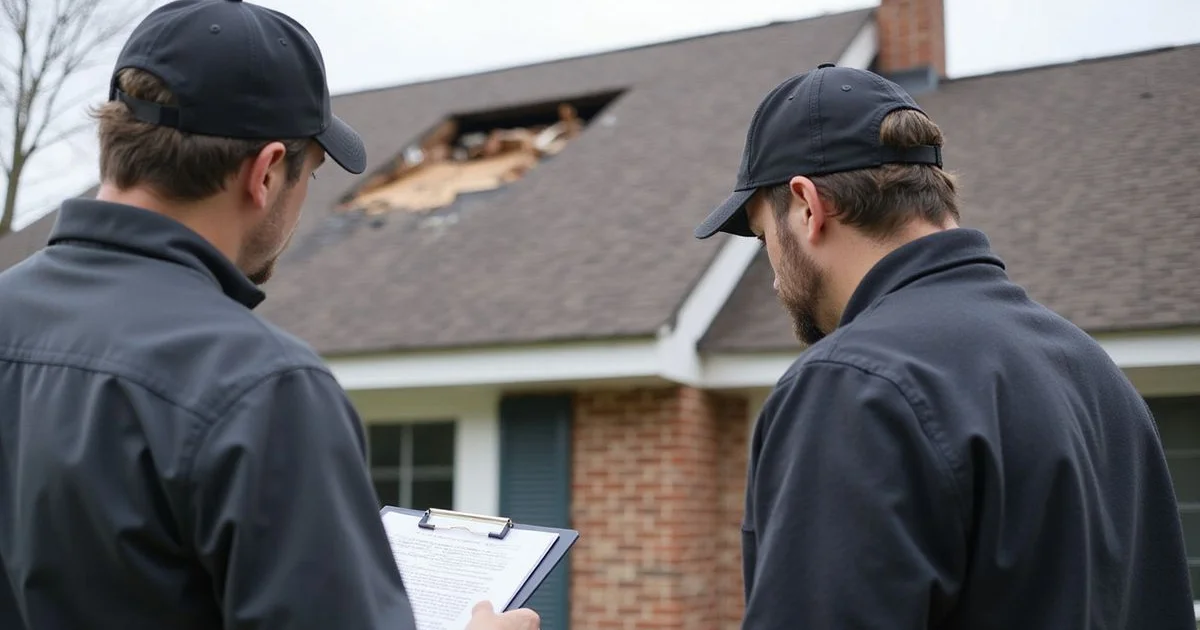
Every spring in Ohio, two things arrive together: the storm season and the storm chasers. Within 48 hours of a significant hail or wind event in Fairfield County, out-of-state roofing contractors flood the area — knocking on doors, offering "free inspections," and pressuring homeowners to sign contracts before the ink dries. The Ohio Attorney General fields hundreds of complaints about predatory roofing contractors every year, and that number climbs every time a major weather system crosses the state.
This guide gives you the tools to spot a scam contractor before you sign anything, verify that any contractor you consider is legitimate, and know exactly what to do if you have already been victimized. Keep it bookmarked and share it with neighbors — knowledge is the most effective protection against storm chasers. For a specific 12-question checklist to run on any contractor before you sign, see our Ohio contractor vetting guide.
Who Are Storm Chasers and Why Ohio Gets Hit Hard
Storm chasing is not a roofing specialty — it is a business model built on exploiting homeowners when they are at their most vulnerable. The typical storm chaser is an out-of-state contractor (or a rotating crew operating under a temporary local name) who monitors severe weather alerts and dispatches crews to affected communities within 24 to 48 hours of a major hail or wind event.
Ohio is one of the most targeted states in the country for this activity, and for good reason. The state sits in the transition zone between cold northern air masses and warm Gulf moisture, creating a highly active corridor for severe thunderstorms, large hail, and straight-line wind events that can affect dozens of communities in a single day. NOAA logged hail on about 2 days a year in Fairfield County from 2000 to 2025, mostly between April and July. After a notable storm, a neighborhood that has one hundred homes in need of roof inspections is a bonanza for storm chasers who have perfected a high-volume, low-quality sales process.
The typical storm chaser approach follows a predictable script. A truck with out-of-state plates pulls up to your curb the morning after a storm. A friendly person in a polo shirt explains that they were "just in the area helping neighbors" and noticed damage on your roof. They offer a free inspection and mention they work directly with insurance companies, implying they can make the process effortless. The inspection takes ten minutes. They produce a handwritten or printed estimate on the spot and ask you to sign an Assignment of Benefits or a contract that day — before the insurance adjuster has even been called. They accept the deductible waiver as a courtesy and promise your roof will be finished within days.
What actually happens in the worst cases: the work is done quickly and poorly, often with cheap materials that do not match the manufacturer specifications required for your warranty. The contractor collects the insurance payment, disputes arise over the workmanship, and by the time you file a complaint, the company name has been dissolved and the crew has moved on to the next storm-affected market three states away.
9 Red Flags of a Predatory Roofing Contractor
None of these red flags on their own is an automatic disqualifier, but any one of them should trigger deeper scrutiny. Seeing two or more together should prompt you to walk away.
Unsolicited door-to-door solicitation after a storm. Legitimate local contractors do not need to canvass neighborhoods because they have established relationships and referral networks. A contractor who shows up at your door within 48 hours of a storm — before you have even called your insurance company — is operating on a storm-chasing model.
Demands full payment upfront. Established contractors require a deposit (typically 10–30%) to order materials, with the balance due at completion or in staged payments tied to project milestones. Any contractor who demands full payment before work begins has no financial incentive to complete the job.
Offers to waive, absorb, or "cover" your insurance deductible. This is not a bargaining chip — it is a crime in Ohio under ORC 3901.78. The contractor inflates the claim to cover the deductible, which constitutes insurance fraud. Your acceptance of this arrangement also exposes you to legal liability.
Has no verifiable Ohio business address. A P.O. box is not a business address. A hotel address is not a business address. Any contractor who cannot provide a verifiable physical street address in Ohio — one you can map, drive to, and verify — has no roots in the community and no accountability if things go wrong.
Cannot produce a current certificate of liability insurance. Every legitimate contractor carries general liability insurance and workers' compensation. They should be able to email or hand you a certificate of insurance within the hour. A contractor who stalls, makes excuses, or produces an expired certificate is not properly insured — meaning you are liable for any injury or damage that occurs on your property.
Uses same-day pressure tactics. "This price is only good today." "We only have one crew available and they're leaving the area tomorrow." "You'll lose your spot if you don't sign right now." These are sales pressure tactics designed to prevent you from doing due diligence. A contractor confident in their work never needs to pressure you into a same-day signature.
Provides only a verbal estimate with no written contract. Ohio law requires written contracts for home improvement work above certain thresholds, but beyond the legal requirement, a verbal-only estimate is a practical trap. Without a written, itemized scope of work, you have no recourse when inferior materials are substituted or work is left incomplete.
Has no review history older than six months. A business that was registered six months ago and has 40 five-star reviews but no reviews before the last storm season is almost certainly a newly created entity by a transient operation. Search Google, BBB, and Angi specifically looking for reviews that span multiple years and mention the same company name consistently.
Refuses to pull permits or dismisses the need for one. In Ohio, roofing work that involves structural repair or full replacement requires a building permit in most jurisdictions. A contractor who says "permits just slow things down" or "we don't need one for this" is either unfamiliar with local code or deliberately avoiding the paper trail that comes with inspected work. Unpermitted work can create problems when you sell your home or file a future insurance claim.
How to Verify a Roofing Contractor Is Legitimate in Ohio
Verification takes less than thirty minutes and can save you thousands of dollars. Run all five of these checks before signing any contract.
Step 1: Ohio Secretary of State Business Search. Go to ohiosos.gov and search for the contractor's business name. A legitimate Ohio business will appear in the search results with an active status, a registered agent, and a formation date that precedes the most recent storm season. If the company does not appear, or if it was registered within the last few months, treat that as a significant red flag. Note that some legitimate sole proprietors may operate under a different structure — ask them directly for their registration information if the business search does not return results.
Step 2: Request a Certificate of Liability Insurance. Ask the contractor to provide a certificate of insurance (COI) that names you as an additionally insured party for the duration of the project. The COI should list both general liability coverage (minimum $1 million per occurrence for roofing work) and workers' compensation. Call the insurance company listed on the certificate to confirm the policy is active before work begins.
Step 3: Verify a Physical Business Address. Plug the address provided into Google Maps and look at Street View. Does a legitimate-looking business exist there? Search the address independently — does it show up associated with the same company name in other directories? A P.O. box, a UPS Store address, or an address that shows a residence with no business signage are all cause for concern.
Step 4: Check Multi-Year Review History. On Google, scroll past the most recent reviews and specifically look for reviews from one to three years ago. Check the BBB profile at bbb.org to see if the company has an established complaint history. Check Angi (formerly Angie's List) for verified project reviews. A company with consistent positive reviews spanning multiple years, mentioning specific employees or owners by name, and describing recognizable local addresses is demonstrating genuine community roots.
Step 5: Confirm They Pull Permits. Ask directly: "Will you pull the building permit for this project?" The answer should be an unequivocal yes. You can also verify after the fact by calling your local building department — in Lancaster, that is the City of Lancaster Building Department — and asking whether a permit has been pulled for your address. If a contractor pulled a permit under a different company name than the one on your contract, that is also worth investigating.
What a Legitimate Roofing Contract Must Include
Never sign a roofing contract that has blank spaces, uses vague language like "standard materials," or lacks any of the following elements. A legitimate contractor will have no objection to including all of these items.
| Contract Element | What to Look For |
|---|---|
| Contractor Legal Name & Address | Full legal business name, Ohio physical street address, phone number, and email |
| License / Registration Number | Ohio contractor registration or applicable county/municipal license number |
| Scope of Work | Specific description: full tear-off vs. overlay, number of layers, deck inspection, flashing replacement |
| Materials Specification | Manufacturer name, product line, color code — not just "30-year shingles" |
| Underlayment & Ice Guard | Specific products listed; ice and water shield required at eaves in Ohio |
| Total Price & Payment Schedule | Deposit amount, milestone payments if any, final payment due at completion |
| Start & Completion Dates | Estimated start window and projected completion date |
| Permit Responsibility | Explicitly states contractor will obtain and pay for all required permits |
| Cleanup & Disposal | States contractor is responsible for all debris removal including nail sweep |
| Manufacturer Warranty | Specific warranty term for the materials; states contractor will register the warranty |
| Workmanship Warranty | Separate warranty from the contractor for labor — minimum 2 years, ideally 5+ |
| Cancellation Policy | Ohio's Home Solicitation Sales Act provides a 3-day cancellation right for door-to-door sales |
If a contractor presents you with a contract missing multiple items from this list, do not sign it. Ask them to revise it. A contractor who refuses to provide a complete written contract is not a contractor you want working on your home.
Why Deductible Waivers Are Illegal in Ohio (And Dangerous for You)
The offer sounds generous: "We'll take care of your deductible — you won't pay a dime out of pocket." In practice, this offer is illegal, financially harmful, and carries real legal risk for you as the homeowner.
Ohio Revised Code Section 3901.78 explicitly prohibits any contractor from directly or indirectly waiving, absorbing, rebating, or otherwise paying a homeowner's insurance deductible as an inducement to enter a contract. The law applies to both the contractor making the offer and to the arrangement itself — meaning the transaction is illegal regardless of how it is structured.
How does a contractor actually "cover" your deductible? They inflate the insurance claim. If your deductible is $2,000 and the legitimate replacement cost is $14,000, the contractor bills the insurance company $16,000 and uses the extra $2,000 to offset your out-of-pocket cost. This is insurance fraud. It artificially inflates claims data, which contributes to rising premiums for every Ohio homeowner. And it means the insurance company paid $16,000 for a $14,000 job — a discrepancy that can trigger an audit, claim denial, or policy cancellation for you.
If the fraud is discovered, the contractor faces criminal charges. But you, the homeowner, can also face charges for participating in an insurance fraud scheme — even if you did not initiate it and believed the offer was legitimate. The Ohio Department of Insurance investigates these complaints actively. If a contractor makes this offer to you, the correct response is to end the conversation, document that it was offered, and report it to the ODI at insurance.ohio.gov.
10 Questions to Ask Every Roofing Contractor Before Signing
Print this checklist and keep it handy when interviewing contractors. A legitimate contractor will answer every one of these questions directly and without hesitation.
- Can you provide your Ohio business registration number? — Confirms the business is legally registered in Ohio and not a fly-by-night operation.
- Can I get a certificate of liability insurance today? — A yes with immediate delivery is the only acceptable answer.
- Do you pull your own permits? — Should always be yes for any full replacement or structural repair.
- How long have you been operating in Fairfield County? — Look for contractors with established local history, not just recent arrivals.
- Can you provide 3 local references from the past 12 months? — Call them. Ask specifically about communication, cleanup, and whether the final price matched the estimate.
- What materials specifically are you proposing? — Get manufacturer name, product line, and color code — not generic descriptions.
- What does your workmanship warranty cover and for how long? — Get the answer in writing in the contract, not just verbally.
- What is the payment schedule? — Any answer that includes full payment before work starts is unacceptable.
- Who is my point of contact during the project? — You should have a named person and direct contact number, not a general company line.
- What happens if additional damage is found during tear-off? — A legitimate contractor will explain their process for documenting additional damage, getting your approval, and adjusting the contract before proceeding.
What a Trustworthy Local Roofing Contractor Looks Like
Understanding the red flags is most useful when you know what the green flags look like too. Here is what separates an established, accountable local contractor from a storm chaser.
A trustworthy local contractor has been in business in the same community for multiple years — ideally a decade or more. Their Google Business profile shows a consistent stream of reviews across multiple years, mentioning projects by address or neighborhood that you can verify are local. They have a physical office you can visit, with a named owner or owners whose faces appear on the website and who are findable on LinkedIn or in local business directories. They are known to local building departments because they pull permits consistently. They hold manufacturer certifications — such as Owens Corning Preferred Contractor or GAF Master Elite status — which require training, insurance verification, and customer satisfaction standards to maintain.
When you call them, you reach a real person or get a timely callback. When they come to your home, they measure your roof, inspect your attic if accessible, and take time to explain what they found. They do not pressure you to sign the same day. They provide a detailed written estimate within 24 to 48 hours and are willing to walk you through every line item.
Fairfield Peak Roofing has connected homeowners with owner-operated, independent contractors serving Lancaster and Fairfield County for years. You can read about our story and our team on the About Us page. When you hire us, you know exactly who will answer the phone if a problem arises — not just today, but in five years when you have a warranty question.
If You've Already Been Scammed: What to Do
If you realize after the fact that you hired a predatory contractor, take these steps immediately — the sooner you act, the more options you have.
Stop payments if possible. If you paid by credit card, contact your card issuer and dispute the charge under the Fair Credit Billing Act. If you wrote a check that has not cleared, contact your bank. If you paid by wire transfer or cash, those funds are harder to recover but not necessarily gone — especially if you can demonstrate fraud.
Document everything. Gather every piece of paper related to the project: the contract, any receipts, text messages, voicemails, and emails. Take photographs of the completed work from multiple angles. If the work is visibly defective, have it inspected by a second licensed contractor who can provide a written assessment comparing the work to the contracted scope and applicable building codes.
Do not allow additional work. If the contractor returns and offers to fix problems, do not allow them back on your property until you have consulted with an attorney. Additional work by the same contractor can complicate your legal claims.
Consult an attorney. If you paid a significant sum and received defective work or no work, an attorney specializing in consumer fraud or contract law can advise you on options including breach of contract claims, fraud claims, and recovery through the Ohio Consumer Sales Practices Act, which allows for treble damages and attorney fees in cases of knowing violations.
How to Report a Roofing Scam in Ohio
Filing a report matters even if you do not expect to recover money. Each complaint helps authorities identify patterns, track serial offenders, and warn other Ohio homeowners. Report to all of the following:
- Ohio Attorney General's Office: Call 800-282-0515 or file online at ohioattorneygeneral.gov. The OAG's Consumer Protection Section investigates contractor fraud under the Ohio Consumer Sales Practices Act.
- Better Business Bureau: File a complaint at bbb.org. BBB complaints are publicly visible and help other consumers identify problem contractors before hiring them.
- Ohio Department of Insurance: If the contractor made an offer to waive your deductible or if there was any suspected insurance fraud, file a complaint at insurance.ohio.gov or call 800-686-1526.
- Ohio Department of Commerce: For issues related to contractor licensing or registration, contact the Division of Industrial Compliance.
- Local County Prosecutor: If money was stolen or fraud resulted in financial loss, your county prosecutor's office can evaluate whether criminal charges are appropriate. In Fairfield County, that is the Fairfield County Prosecutor's Office.
Do not be discouraged from filing a report because you feel embarrassed or because the contractor has already left the area. Many enforcement actions are built from clusters of complaints filed across multiple counties after the same storm event. Your report may be the one that triggers an investigation.
Why Choosing a Local, Owner-Operated Contractor Protects You
There is a simple question that separates a local contractor from a storm chaser: where will they be in five years?
A roofing contractor who lives and works in your community has every incentive to do the job right the first time. Their reputation is built on word of mouth in the same neighborhoods where they operate. Their children go to school with your children. Their trucks have been parked in front of your neighbors' homes for years. When a warranty issue comes up three years from now, you know where to find them — and they know that their continued success in this market depends on making it right.
Storm chasers have no such stake. They are optimizing for maximum volume in the weeks following a storm event, not for the long-term satisfaction of a customer they will likely never see again.
When you hire a local, owner-operated roofing contractor, you are not just buying a new roof — you are buying accountability. The ability to drive to a real office, speak to a named owner, and hold someone responsible if things go wrong is worth more than any discount a storm chaser might offer. To learn more about Fairfield Peak Roofing's history and commitment to Fairfield County homeowners, visit our About Us page. When you are ready to schedule an inspection or get a written estimate, reach out to our team directly.
Your roof is one of the most significant investments you will make in your home. Protecting that investment starts with choosing who works on it.
Need Help with Your Roof?
Get an inspection and estimate from Lancaster's most trusted roofing team.