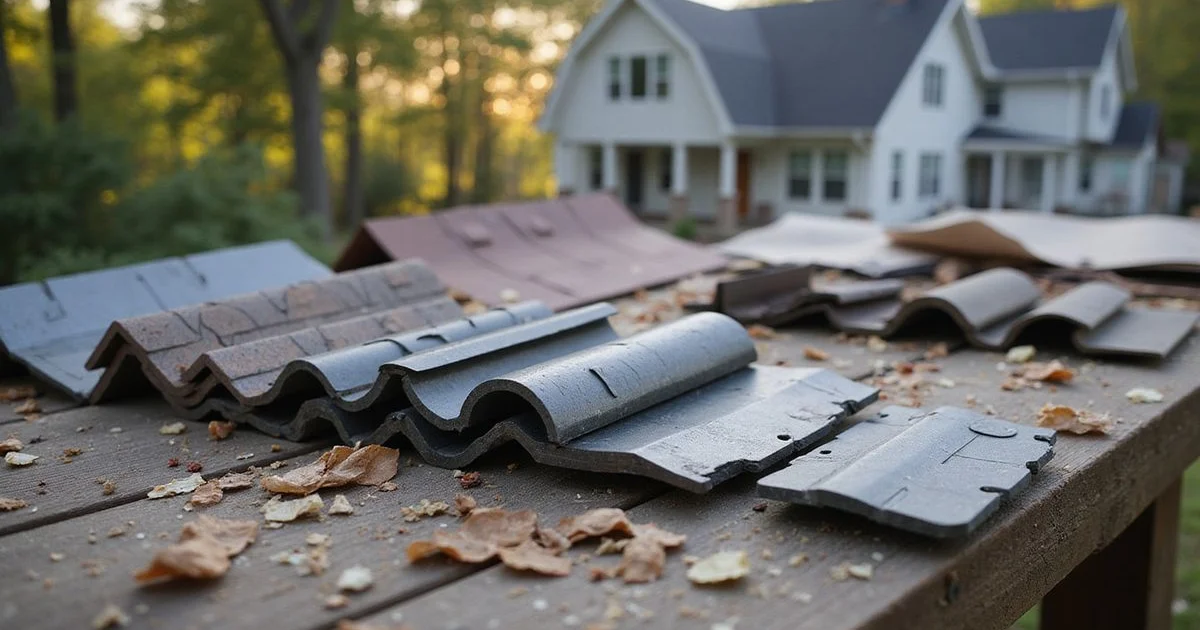
A roof replacement in Ohio costs between $8,500 and $22,000. For most households, that's not a number you write a check for. But a failing roof can't wait while you save — water damage compounds fast, and what costs $12,000 to replace today can cost $30,000 to repair after two wet winters. Here are the six most practical financing paths available to Ohio homeowners in 2026.
Why Financing a Roof Is Often the Smart Financial Decision
The instinct to avoid debt is understandable, but when it comes to a compromised roof, the math almost always favors action. A roof that is actively leaking or structurally weakened is not a static problem — it is a compounding one. Water finds every path of least resistance. A single failed flashing point can saturate roof decking, rot rafters, soak attic insulation, and eventually stain interior drywall, all within a single Ohio winter.
Consider a concrete example. A homeowner with a 22-year-old roof delays replacement for 18 months to save money. During that time, two ice dam events push water under the shingles and into the attic. By the time they call a contractor, the job has grown from a $12,000 roof replacement to a $20,000 project that now includes rotted decking, damaged insulation, and a mold remediation bill. The financing cost on that original $12,000 at 8% APR over five years would have been roughly $2,600 in interest — a fraction of the $8,000 in avoidable damage.
The question is not whether you can afford to finance a new roof. It is whether you can afford not to.
Option 1: Your Homeowners Insurance (The Best-Case Path)
If your roof has been damaged by wind, hail, ice, or a fallen tree, your homeowners insurance policy is the first place to look — not the last. A qualifying claim typically covers the full replacement cost of your roof minus your deductible, which for most Ohio policies runs between $500 and $2,500. That makes insurance the only financing path where you may walk away with a brand-new roof for a four-figure out-of-pocket cost.
The catch is that insurance covers sudden, event-driven damage — not wear and normal aging. If your adjuster determines the damage is the result of deferred maintenance rather than a covered peril, the claim will be denied. This is why documenting storm events promptly is critical. Ohio experiences significant hail and severe wind every year, and many homeowners do not realize their roof sustained damage until granule loss, lifted shingles, or interior leaks appear months later.
Before you sign any contractor financing agreement, ask yourself whether storm damage played a role in your roof's current condition. If the answer is possibly, file the claim first. For a step-by-step walkthrough, read our guide on how to file a roof insurance claim in Ohio. If you have already had a leak and are wondering whether your policy covers it, see does homeowners insurance cover roof leaks in Ohio.
Key steps if you pursue an insurance claim:
- Document the damage immediately with dated photographs after any storm event.
- Call your insurer within the policy's reporting window — many Ohio policies require notice within 30 to 60 days of a weather event.
- Get an independent contractor estimate before the adjuster visit so you have a basis for comparison.
- Do not sign a contractor's Assignment of Benefits form until you understand what rights you are relinquishing.
Option 2: Contractor-Arranged Financing & Payment Plans
Many Ohio roofing contractors partner with third-party lenders — most commonly GreenSky, Synchrony Home, or regional credit unions — to offer point-of-sale financing directly at the time of estimate. These programs are convenient, require no home equity, and are often approved within minutes of a credit check. For homeowners who do not want to shop lenders separately, this is a practical starting point.
The most attractive feature of contractor financing is the promotional 0% APR offer. A 12- or 24-month deferred interest plan can be genuinely interest-free — if and only if you pay the full balance before the promotional period ends. Here is where many homeowners are caught off guard: most of these plans use deferred interest, not true 0% interest. If even one dollar remains at the end of the promotional period, all of the accumulated interest retroactively charges to your account at the full rate, which is typically 26.99% or higher. Read every line of the financing agreement before you sign.
| Term | Interest Rate | Best For |
|---|---|---|
| 12-month 0% | 0% if paid off in full | Small repairs or short payoff timeline |
| 24-month 0% | 0% if paid off in full | Mid-range replacements, disciplined payoff |
| 60-month fixed | 7%–12% APR | Full replacement, budget monthly payments |
| 84-month fixed | 9%–15% APR | Larger projects, stretched budget |
Questions to ask before signing a contractor financing agreement:
- Is this a true 0% APR or a deferred interest promotion?
- What is the standard APR if I do not pay off the balance in time?
- Are there prepayment penalties?
- Is the lender a separate entity from the contractor, and who services the loan?
Option 3: Home Equity Loan or HELOC
For homeowners who have built meaningful equity — typically defined as at least 15% to 20% after the new loan is factored in — a home equity loan or Home Equity Line of Credit (HELOC) is usually the lowest-rate secured financing path available.
The distinction between the two products matters:
- A home equity loan delivers a lump sum at a fixed interest rate, repaid in equal monthly installments over 5 to 20 years. It is predictable and straightforward. In 2026, Ohio homeowners with strong credit are seeing home equity loan rates in the 6%–8% APR range.
- A HELOC is a revolving line of credit secured by your home, typically at a variable rate tied to the prime rate. You draw what you need, when you need it. Current HELOC rates for well-qualified Ohio borrowers are in the 7%–9% APR range, though the variable nature means your payment can change over time.
The primary advantage of both products is cost: lower rates than unsecured personal loans or credit cards, and interest may be tax-deductible if the funds are used for home improvements (consult a tax professional). The primary disadvantage is that your home serves as collateral. A failure to repay puts your property at risk. Additionally, approval timelines run longer than personal loans — typically two to four weeks — which may not work if your roof is actively leaking and you need to move quickly.
Home equity financing works best for established homeowners who purchased several years ago, have significant equity, and are replacing a roof on a planned rather than emergency timeline.
Option 4: Unsecured Personal Loan
An unsecured personal loan is the most flexible financing option for Ohio homeowners who lack sufficient equity, are earlier in their mortgage, or simply do not want to put their home up as collateral. Ohio banks, credit unions, and online lenders all offer personal loans for home improvement, typically with terms ranging from 2 to 7 years.
The rate range in 2026 is wide: roughly 6% to 24% APR depending on your credit score, income, debt-to-income ratio, and chosen lender. Borrowers with credit scores above 720 can generally qualify for rates in the 6%–12% range, while those with scores in the 620–680 range may see offers closer to 18%–24%.
Key advantages of a personal loan:
- No home equity required. Available to newer homeowners and those who have not built substantial equity.
- Fast approval. Many online lenders and credit unions fund within one to three business days of approval — important if your roof situation is urgent.
- No lien on your home. Default consequences, while serious, do not directly threaten your home's title the way a secured loan does.
- Fixed rate, fixed payment. Monthly obligations are predictable for the life of the loan.
The key disadvantage is cost: personal loan rates are higher than home equity products. Ohio credit unions — including Wright-Patt, Kemba, and members of the Ohio Credit Union League — tend to offer the most competitive personal loan rates for qualifying members. It is worth becoming a member of a local credit union before you need to borrow.
Option 5: FHA Title I Home Improvement Loan
The FHA Title I Home Improvement Loan program is a federal program administered through HUD-approved lenders that allows homeowners to borrow for home improvements without equity requirements on smaller loan amounts. Loans up to $7,500 are available on an unsecured basis; loans between $7,500 and $25,000 require the home as collateral.
For a roof replacement in the $8,500–$14,000 range, a Title I loan can be an attractive option, particularly for lower-income Ohio homeowners who may not qualify for conventional financing. The rates are not subsidized — they are set by individual approved lenders — but the program's government backing often makes approval accessible to borrowers who would not qualify otherwise.
To apply, you must find a HUD-approved Title I lender in Ohio. The HUD lender search tool at hud.gov allows you to filter by state and loan type. Key eligibility requirements include:
- The property must be your primary residence and have been occupied for at least 90 days.
- The improvement must be classified as a permanent structural improvement that protects or improves the basic livability of the property — roof replacement qualifies.
- There is no minimum credit score set by HUD, though individual lenders set their own thresholds.
Option 6: IRA Tax Credits and Ohio Energy Efficiency Programs
The Inflation Reduction Act's Energy Efficient Home Improvement Credit (Section 25C) does not cover standard asphalt shingle replacement as a stand-alone project. However, if your roof replacement is paired with qualifying upgrades — specifically attic insulation, air sealing, or ventilation improvements — those associated costs may be eligible for a tax credit of up to $1,200 per year.
The practical implication for Ohio homeowners: if you are replacing an aging roof that was contributing to heat loss — common in homes with inadequate attic insulation — bundling new insulation and air sealing into the same project creates a legitimate opportunity for a federal tax credit on those line items. The insulation must meet applicable IECC standards for your climate zone. A tax professional should review your specific situation before you file a claim.
At the state level, Ohio's POWER+ program (administered through the Ohio Development Services Agency) provides rebates and low-interest financing for qualifying energy efficiency improvements in residential properties. Eligibility requirements and available incentive amounts change periodically; check ohiohome.org or contact the Ohio Development Services Agency for current program details.
These programs are not a primary financing path for a full roof replacement, but they can meaningfully offset the cost of associated upgrades and reduce your net out-of-pocket. Do not leave money on the table by failing to ask your contractor which line items in their estimate may qualify.
What NOT to Do When Financing a Roof
Understanding the wrong paths is as important as knowing the right ones.
- Do not skip a failing roof to save money. The math is unambiguous: deferred roof replacement nearly always costs more in the long run. Water damage accelerates structurally and financially.
- Do not put a full roof replacement on a high-rate credit card. A $12,000 balance at 24% APR with minimum payments will cost you tens of thousands in interest and take decades to pay off. Credit cards are appropriate for small emergency repairs only, and only if you can pay the balance within one to two billing cycles.
- Do not sign a contractor's deferred interest financing agreement without understanding the terms. “No interest if paid in full” is not the same as “0% APR.” Ask specifically: what happens if I have a balance on day one after the promotional period?
- Do not waive your insurance rights to get a “deal.” Some contractors offer a discounted price in exchange for the homeowner not filing an insurance claim. This arrangement may violate your policy terms and could expose you to fraud liability in Ohio. If you have a legitimate claim, file it.
- Do not take the first financing offer without comparison shopping. Get quotes from at least two lenders. A one-percentage-point difference in APR on a $12,000, five-year loan is worth over $300 in savings.
Before You Finance: The 5-Question Checklist
Before you choose a financing path, work through these five questions in order. Each answer eliminates or elevates options.
- Is there any possibility of covered storm or weather damage on my roof? If yes — even a small possibility — call your insurer before signing anything with a contractor. An insurance claim that covers the replacement means you may need no financing at all beyond your deductible.
- What is my approximate credit score range? Scores above 720 open the full range of financing options at competitive rates. Scores in the 620–680 range still have options, but rates will be higher and some products may not be available. Knowing your range before you start shopping prevents unnecessary hard inquiries.
- Do I have meaningful home equity? If you have owned your home for five or more years and property values have held, you likely have equity. Check your most recent mortgage statement for the current balance and compare it to an estimated current market value. If you have 20% or more equity after the new loan, a home equity product is worth pursuing.
- What monthly payment can I realistically sustain? Use a simple loan calculator: a $12,000 loan at 8% over 60 months is $243/month. At the same rate over 84 months it is $187/month. Choose a term where the payment does not strain your monthly budget, even in months with unexpected expenses.
- What is my realistic payoff timeline for a promotional offer? If a contractor offers you 24-month 0% financing, be honest: will you have $12,000 available to pay it off in 23 months? If the answer is uncertain, a fixed-rate term loan at 8%–10% may be the safer choice, even though the rate looks worse on paper.
How to Get a Written Estimate to Start the Process
Every financing conversation starts with a number. You cannot evaluate loan terms, compare monthly payments, or determine whether your insurance deductible makes a claim worthwhile until you have a written, itemized estimate for your specific roof.
A professional estimate from Fairfield Peak Roofing includes line-item pricing for tear-off and disposal, new decking where needed, underlayment, ice and water shield, shingles, flashing, ridge cap, and ventilation — every component, not just a single total. That level of detail is what lenders need to process applications and what you need to compare options accurately.
Use our roofing material cost estimator to get a rough project range before your inspection, then contact us to schedule a free on-site estimate. We serve Lancaster, Newark, Pickerington, Canal Winchester, Reynoldsburg, and the surrounding communities of Fairfield County and beyond. There is no obligation, and we will walk you through every line item so you understand exactly what you are paying for before you make any financing decision.
Need Help with Your Roof?
Get an inspection and estimate from Lancaster's most trusted roofing team.
