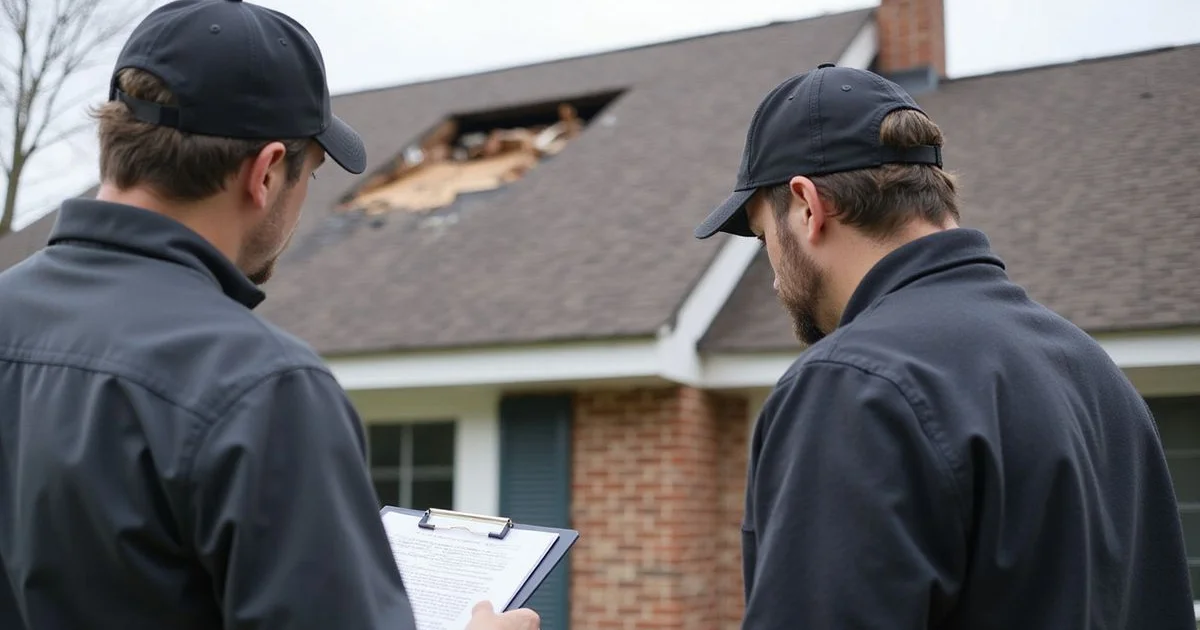
On April 17, 2026, a line of severe storms dropped giant hail across Northeast Ohio — the third significant weather event to roll through the state this spring. Hail the size of golf balls and larger was reported across multiple counties, with wind gusts accompanying the cells pushing 60 mph or higher. Fairfield County and the Lancaster area sit squarely in the same storm corridor that has been lighting up radar all season. If your neighborhood saw heavy rain and heard that sharp crack of ice hitting your roof two days ago, this guide is your next step.
The most expensive mistake homeowners make after a storm is doing nothing in the first 72 hours. Not because the damage gets dramatically worse overnight — but because the clock on your insurance claim, your contractor's documentation, and your own ability to establish a clear date of loss all start ticking the moment the storm passes. This is an action plan. Here's what to do right now.
The 2026 Spring Storm Season in Ohio: What We're Seeing
WJW Fox 8 in Cleveland has characterized this as an "especially stormy spring" for Ohio, and the numbers back that up. The April 17 event produced confirmed giant hail — a National Weather Service designation for stones 1.75 inches or larger — across portions of Northeast Ohio. That's not a minor nuisance. Hail at that size carries enough kinetic energy to crack asphalt shingles, puncture soft metals, and accelerate granule loss on any roof it contacts.
Central Ohio and Fairfield County are not always the direct target of these systems, but that's the wrong way to think about risk. The same frontal boundaries that dropped golf ball hail northeast of us can produce large hail, damaging wind, and tornado warnings as they track south and east. We saw tornado threats on April 18 and 19 as the trailing edge of the system moved through. The pattern this spring — frequent, fast-moving supercell clusters — is the kind that produces surge demand for roof inspections and keeps contractors booked solid within days of a major event.
Ohio's hail season runs roughly April through June. During that window, the state sits at the southern edge of the Great Plains hail corridor, where cold Canadian air still collides with warm Gulf moisture. Spring 2026 has been more active than average because that collision has been happening repeatedly, in quick succession, over the same geographic area.
Here's a quick reference for how hail size translates to roof risk:
| Hail Size | Typical Roof Impact | Recommended Action |
|---|---|---|
| Small (pea-size, <0.5") | Minor granule loss | Monitor at next inspection |
| Medium (marble, 0.5–1") | Granule acceleration, possible soft metal dents | Schedule inspection within 30 days |
| Large (golf ball, 1.75") | Likely shingle bruising, visible damage | Inspect within 7 days |
| Giant (baseball+, 2.75"+) | Structural damage possible | Inspect within 24–48 hours |
The April 17 event produced hail in the large-to-giant range in parts of Northeast Ohio. If you're in Fairfield County and saw hail the size of marbles or larger, the 30-day window applies to you — and sooner is always better.
Your 72-Hour Action Plan After a Storm
When a severe storm passes, most homeowners either go outside immediately to look around or they do nothing at all and assume the roof is fine. Both extremes cost money. Here's the sequence that actually protects you.
Stay safe first. Wait at least 30 minutes after a storm before going outside. Downed power lines, broken tree limbs, and unstable debris are the first hazards. If a large branch fell on your home, do not go near that area until you've confirmed there's no electrical contact.
Do a ground-level visual inspection. Walk the full perimeter of your home. Look for shingle debris on the ground, dented gutters and downspouts, damage to your AC unit's condenser fins, and any visible marks on siding or flashing. If your gutters have dents that look like someone hit them with a ball-peen hammer, your roof took hits too. Those dents are your evidence.
Check your attic. Go into the attic during daylight hours, turn off any lights, and look up. Pinpoints of daylight coming through the decking mean you have open gaps. Also look for any water stains on the wood that weren't there before — fresh stains will look darker and may still be damp.
Document everything with photos and video. Timestamps are critical for insurance. Photograph the granules in your gutters, dented downspouts, fallen debris, and anything else that shows storm activity. Your phone's camera auto-embeds the date and time — use it. Don't clean anything up before you photograph it.
Call your insurance company to report the event. You're not filing a full claim yet — you're establishing a date of loss. Many adjusters will tell you to wait until you have a contractor's estimate anyway. What matters is that you create a record showing you contacted them promptly after the storm date.
Call a licensed local roofing contractor for an inspection. Do not wait for the insurance process to play out before getting a professional on your roof. A written contractor inspection report is what wins claims. It gives adjusters specific, documented damage to evaluate. Without it, you're relying on an adjuster who may spend less than 20 minutes on your roof.
One legal note worth knowing: Ohio law under ORC 3929.07 prohibits contractors from waiving, absorbing, or rebating your insurance deductible. If a contractor offers to "cover your deductible" or says you won't have to pay it, that is insurance fraud — and it puts you at legal risk too. Any legitimate contractor will tell you the same thing.
How to Identify Storm Damage on Your Own
You don't need to get on the roof to do a useful inspection. In fact, we'd strongly recommend against it — the risk of injury is real, especially on a wet or damaged surface, and a certified inspector's documented findings carry far more weight with an insurance adjuster than the homeowner's own assessment. What you can do from the ground with a pair of binoculars is genuinely useful.
Here's what hail damage looks like from the ground or on soft metals you can touch:
- Circular impact marks on shingles — they look like random dark spots, not the directional wear pattern you'd see from normal aging
- Granules piled in gutters and pooled around downspout exits — run your hand along the bottom of a gutter and feel for grit
- Dents on metal flashing, ridge caps, vents, or the aluminum fins of your AC condenser unit
- Lifted or partially missing shingles along the ridge line or rake edges
- Gutters that are bent, sagging, or pulled away from the fascia board
- Dark spots on the roof surface where the shingle's granule coating has been knocked away, exposing bare asphalt
Wind damage looks different. It tends to lift shingles from the bottom edge, crack them along their length, or blow them off entirely. In an Ohio spring storm with both hail and 60-mph gusts, you can have both types of damage on the same roof — hail impacts on the upper surface, wind damage along the edges and ridges.
⚠️ Don't hire a contractor who knocks on your door within 24 hours of a storm.
These "storm chasers" work your neighborhood after major events and often disappear after collecting a deposit — sometimes before the job is even scheduled, let alone completed. Always verify a contractor's Ohio contractor license number before signing anything. You can check licenses at the Ohio Construction Industry Licensing Board (OCILAB) website. A legitimate local contractor welcomes that verification.
Understanding Your Insurance Coverage in Ohio
Not all homeowners policies pay out the same way after a storm damage claim, and the difference can be significant. The two main policy structures are Replacement Cost Value (RCV) and Actual Cash Value (ACV).
An RCV policy pays what it actually costs to replace your roof with a comparable new one at today's prices. An ACV policy pays that same amount minus depreciation based on your roof's age and condition. If your roof is 15 years old and an ACV policy depreciates it at 4% per year, you could be looking at a payout that covers only 40% of the actual replacement cost. You'd owe the rest out of pocket on top of your deductible.
Ohio homeowners also need to be aware of wind and hail deductibles specifically. Many policies in this region have moved away from flat-dollar deductibles for storm claims and instead use a percentage of your home's insured value — typically 1% to 2%. On a home insured for $300,000, that's a $3,000 to $6,000 deductible before the insurance company pays a dime. Check your declarations page before you assume what you'll owe.
The typical claim timeline in Ohio runs like this: (1) you report the event, (2) an adjuster is assigned and schedules a visit, (3) the adjuster produces an estimate called a "scope of loss," (4) the insurance company approves, modifies, or denies the claim. When you get that scope of loss document, request a copy and compare it line-by-line against your contractor's estimate. Adjusters miss items — skylights, ridge caps, gutters, ventilation components. A contractor who works with insurance companies regularly will catch those gaps and submit a supplement.
Ohio's statute of limitations for filing a property insurance claim is generally one year from the date of the storm. Some policies are stricter. Filing within 90 days is a much safer target. The longer you wait, the harder it becomes to connect visible damage to a specific storm event — and insurance companies know that.
Protecting Your Roof Now — Before the Next Cell
The storms that hit April 17 almost certainly won't be the last of the spring season. Ohio's active pattern is expected to continue through May and into June. That means if your roof already has compromised areas — loose flashing, worn granule coating, aged sealant strips — the next round of hail and wind will find those weak spots faster.
Here are practical steps you can take right now:
- Get a professional inspection before the next storm. A roof inspection done now gives you a documented baseline. If damage occurs in a future storm, you have clear before-and-after evidence for your claim. Without that baseline, an adjuster can argue that any damage they find is pre-existing.
- Check your gutters and downspouts for proper drainage. Gutters that are clogged or pulling away from the fascia will overflow during heavy rain and drive water back under the drip edge. Clean them out now and make sure downspouts are directing water at least four feet away from the foundation.
- Trim overhanging branches to at least 6 feet from the roof surface. Wind-driven branches scratch through granule coating and can puncture shingles outright. Any limb within reach of your roof in a 50-mph gust is a liability.
- Verify your attic ventilation. Poor attic ventilation traps heat and moisture, which accelerates shingle aging and makes existing damage worse. It also creates conditions for ice dams in winter. If your attic runs noticeably hot in summer or you've had ice dams before, it's worth having the ventilation system evaluated.
- Consider Class 4 impact-resistant shingles at your next replacement. Class 4 is the highest rating for impact resistance, and Ohio insurance carriers frequently offer premium discounts of 10% to 20% for homes with Class 4 roofs. The product costs more upfront, but between the insurance savings and reduced storm damage exposure, the math often works out over a 10-year horizon.
- Document your current roof condition with dated photos right now. Take photos today, before the next storm. This is your "before" baseline. Store them somewhere you can retrieve them easily — cloud backup tied to your email account works well.
If you want a starting point for evaluating your roof's current condition, try the roof assessment tool on our site. It takes about three minutes and gives you a realistic picture of where your roof stands.
FAQ — Storm Damage Questions Ohio Homeowners Are Asking Right Now
After a major storm event, we get a surge of the same questions. Here are the ones coming in most often this week, answered directly.
How do I know if my roof was damaged in the recent Ohio storms?
Start with the ground-level check: walk your perimeter and look for shingle debris, granules in the gutters, and dents on any soft metal surfaces — gutters, downspouts, vents, and your AC unit. Those dents are the clearest indicator that hail made contact. If you see circular dents on the downspout, your shingles almost certainly took hits too. From there, check your attic for any new water stains or daylight coming through the decking. If you see either, call a contractor the same day.
How long do I have to file a roof insurance claim in Ohio after storm damage?
Most Ohio homeowners policies give you one year from the storm date to file. Some are stricter — 180 days is not uncommon in certain policy forms. The practical answer is: don't count on the full year. Document the damage now, get a contractor's inspection report, and file within 90 days if at all possible. A claim filed promptly with solid documentation is far more likely to be approved than one filed 11 months later when the storm is a distant memory and the evidence has been rained on a dozen more times.
What is the difference between hail damage and wind damage on a roof?
Hail damage creates circular impact marks on shingles in a random, scattered pattern — not a directional wear line like you'd see from foot traffic or normal aging. It also dents soft metals. Wind damage lifts shingles from their lower edge, cracks them along the length, or removes them entirely. It typically shows up first along the ridge and rake edges where the wind gets underneath. Ohio spring storms commonly deliver both at once, so don't assume you only have one type. A good inspector documents both separately, which matters when the adjuster is reviewing the scope.
Should I put a tarp on my roof after storm damage?
If you have missing shingles, visible holes, or exposed decking, yes — tarp it immediately. Every day without a tarp is a day water can get into the wood deck, insulation, and eventually your ceilings. Use a 6-mil polyethylene tarp, not a lightweight blue tarp. Secure it with 2x4 boards rather than just staples — boards distribute the load and keep the tarp from tearing loose in the next windstorm. Extend the tarp over the ridge by at least 4 feet so rain doesn't funnel in from the top. And photograph the damage before and after tarping. That before photo is important for your insurance claim.
Are roofing contractors more expensive after a major storm?
Reputable local contractors do get booked out faster after major storm events. You might be looking at a 2- to 4-week wait for scheduling during a busy storm season. That's normal and not the same as price gouging — it's just supply and demand on labor. What you should watch for are contractors who inflate their estimates dramatically post-storm, or who pressure you to sign a contract on the spot. Both are red flags. Out-of-state storm chasers who show up in your neighborhood within 48 hours of a major event are the highest-risk category — they often collect a deposit, do substandard work with no local accountability, and are gone before any warranty issue surfaces. Stick with a licensed local contractor you can verify and reach by phone six months from now.
Storm Hit Your Area? Get a Free Inspection.
Fairfield Peak Roofing is scheduling storm damage inspections throughout Lancaster, Pickerington, Canal Winchester, and Fairfield County. Contractors in our network document damage for insurance, provide written estimates, and work directly with adjusters. Don't wait.