TPO, EPDM, and PVC cover the vast majority of commercial flat roofs installed in Ohio today. Each is a single-ply membrane roofing system, but they differ in material chemistry, seam technology, cost, and performance in specific conditions. Picking the wrong one for your building's use case costs money twice: once at installation, and again when the system fails prematurely or requires a full replacement instead of a re-cover. This guide gives you the technical and financial information to make the right call for a Fairfield County commercial building.
What is TPO roofing and when does it make sense for Ohio commercial buildings?
TPO (thermoplastic polyolefin) is currently the most installed commercial roofing membrane in the US, holding roughly 40% of the market according to NRCA data. It's a single-ply white membrane installed in sheets that are heat-welded at the seams using hot-air welding equipment.
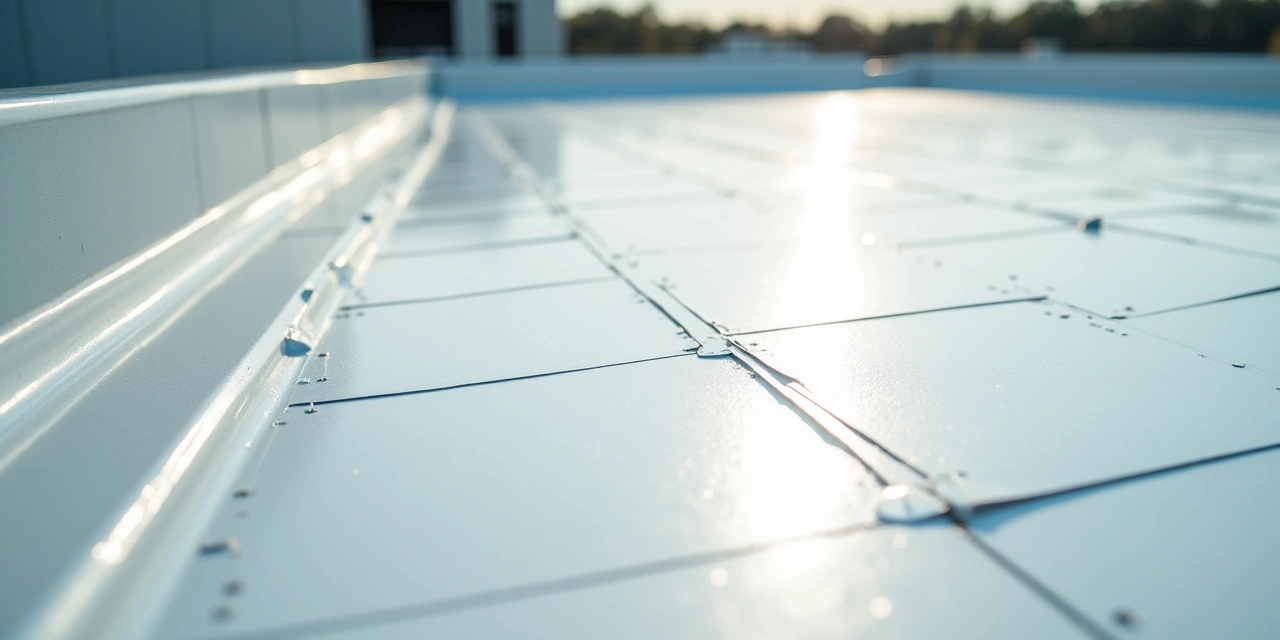
The heat-welded seam is TPO's primary technical advantage. A properly welded TPO seam creates a bond as strong as the membrane itself. It doesn't rely on adhesive that can fail in cold temperatures. In Ohio's winters, where sub-20°F days are not unusual, this matters.
TPO's white reflective surface qualifies for ENERGY STAR certification and reduces cooling loads in summer. For Ohio buildings with significant solar exposure, reflective roofing can cut cooling costs by 15-25%. That energy savings partially offsets the cost premium over black EPDM.
TPO makes sense for most Ohio commercial buildings: office, retail, light industrial, warehouse, and multi-tenant commercial. It's the right default choice unless your building has a specific chemical or grease exposure that TPO can't handle, or you have an unusually tight budget that pushes you toward EPDM.
Material cost: $3-$6 per square foot. Installed cost: $8-$14 per square foot.
What is EPDM roofing and who should use it?
EPDM (ethylene propylene diene monomer) is a synthetic rubber membrane and the most installed commercial roofing membrane globally. It comes in black or white, in large sheets up to 50 feet wide that minimize seam count. Installation is typically adhesive-bonded or mechanically fastened rather than heat-welded.
The seam is EPDM's vulnerability in Ohio. Adhesive-bonded EPDM seams rely on contact cement or tape that maintains bond strength through expansion and contraction. Below 20°F, that adhesive becomes brittle. Ohio averages multiple days per winter below that threshold, and Fairfield County's 40-55 freeze-thaw cycles per year create repeated mechanical stress at seam locations. Adhesive pull-back is the most common failure mode on aging EPDM systems in this climate.
EPDM still makes sense in specific scenarios. Large, simple roof decks with minimal penetrations and long runs between seams minimize the adhesive seam vulnerability. Budget-constrained projects where the owner has a defined hold period shorter than EPDM's design life. Buildings where reflectivity is not a concern (EPDM black absorbs heat rather than reflecting it, which can actually be beneficial on a building with high heating loads).
Material cost: $2-$5 per square foot. Installed cost: $7-$12 per square foot. EPDM is the lowest-cost installed option of the three.
What is PVC roofing and when is it worth the premium?
PVC (polyvinyl chloride) is a thermoplastic membrane, white in color, installed with heat-welded seams like TPO. The seam technology and reflective surface are similar between TPO and PVC. What sets PVC apart is chemical resistance.
PVC resists degradation from oils, greases, and a wide range of industrial solvents. TPO and EPDM break down when exposed to these substances. For restaurant buildings with rooftop exhaust that deposits cooking grease, food processing facilities, chemical manufacturing, and industrial applications where the membrane surface contacts airborne chemicals, PVC is the correct choice. In those environments, TPO fails in 5-10 years in areas of direct grease exposure. PVC handles it for the full design life.
PVC is preferred by many manufacturers for restaurant and food service applications specifically because of this. It's also the system of choice for green roof assemblies where the membrane contacts soil and organic material.
The premium over TPO is real: $2-$5 more per square foot installed. On a 10,000 sq ft roof, that's $20,000-$50,000 more than TPO. Don't pay that premium unless your building actually generates the chemical exposure PVC is designed to handle.
Material cost: $4-$7 per square foot. Installed cost: $10-$17 per square foot.
How do TPO, EPDM, and PVC compare in cost?
Here is the full technical comparison across key categories:
| Category | TPO | EPDM | PVC |
|---|---|---|---|
| Material cost/sq ft | $3–$6 | $2–$5 | $4–$7 |
| Installed cost/sq ft | $8–$14 | $7–$12 | $10–$17 |
| Lifespan | 20–30 yrs | 25–30 yrs | 20–30 yrs |
| Color | White (reflective) | Black or white | White (reflective) |
| Heat-welded seams | Yes | No | Yes |
| Chemical resistance | Moderate | Low | High |
| Ohio winter performance | Good | Good (seams vulnerable) | Good |
| Best for | Most buildings | Budget, large simple roofs | Grease, chemicals |
On a strictly cost-per-year-of-life basis, EPDM and TPO are close when EPDM is maintained well. PVC's premium becomes worthwhile only when chemical resistance is required. For Ohio buildings without that requirement, the typical recommendation is TPO as the default and EPDM as the budget alternative on straightforward roofs.
Which membrane handles Ohio's climate best?
Ohio's climate stresses all three systems in different ways. Here's how each performs against the state's specific weather patterns.
Freeze-thaw cycles (40-55 per year in Fairfield County): TPO and PVC handle this best because heat-welded seams don't rely on adhesive that can fail at low temperatures. EPDM's adhesive seams are the system's weak point in Ohio winters. Cold-temperature adhesive failure is the most common cause of EPDM leak callbacks in this climate.
UV exposure: All three systems degrade under UV over time. UV degradation is a factor on any uncoated membrane. TPO and PVC white surfaces reflect UV more effectively than black EPDM, reducing surface temperature and slowing thermal degradation. White EPDM addresses this partially but at added cost.
Summer heat: Black EPDM absorbs heat, raising roof surface temperatures to 150-170°F on hot Ohio summer days. That thermal cycling accelerates membrane aging and increases HVAC cooling loads. TPO and PVC white surfaces reflect solar energy and stay significantly cooler, which extends membrane life and reduces building energy use.
Hail and impact: All three single-ply membranes have similar hail resistance at standard thickness (45 mil and 60 mil). Thicker membranes (60 mil and above) provide meaningfully better impact resistance for the Ohio hail season. Specify 60 mil minimum on any new installation in Fairfield County.
The bottom line for Ohio: TPO is the best all-around performer in this climate. It combines heat-welded seams that handle freeze-thaw cycles, a reflective surface that reduces thermal load, and mid-range cost. EPDM performs adequately but requires more attention to seam condition during annual inspections. PVC matches TPO in climate performance but costs more.
How do warranties compare across TPO, EPDM, and PVC?
All three systems are available with manufacturer warranties ranging from 10 to 30 years, including NDL (No Dollar Limit) coverage at the premium tier. The warranty structure matters as much as the length.
Standard warranties cover manufacturing defects in the membrane material. They typically exclude installation defects, damage from rooftop traffic, and failure caused by inadequate drainage. Standard warranties are useful protection but limited in practice.
NDL warranties cover the full cost of repair or replacement with no cap on the dollar amount paid. They require installation by a manufacturer-certified contractor, a third-party inspection during installation, and documented annual maintenance inspections thereafter. NDL coverage is the highest-value warranty option for long-term property owners. For investors with a short hold period, the added installation cost for NDL certification may not be justified.
On the Ohio market, NDL warranties are available from major manufacturers (Firestone, Carlisle, GAF, Versico) on all three systems. The incremental cost of NDL-qualifying installation versus standard installation runs $1-$3 per square foot. On a $150,000 project, that's $10,000-$30,000 more upfront for warranty coverage with no repair cost ceiling. For a building you intend to own for 20+ years, that math usually works in your favor.
One critical point: NDL warranties require documented annual inspections. The warranty is void if you can't produce inspection records. Build the documentation requirement into your maintenance contract from day one.
For more on these systems in context, see the full commercial roof cost guide, and our breakdown of flat vs pitched commercial roofing. Our commercial roofing services page covers all three systems for Fairfield County buildings. For ongoing care of whichever system you choose, see the commercial roof maintenance guide.
Frequently Asked Questions
What is the most popular commercial roofing membrane in Ohio?
TPO is currently the most installed commercial membrane in the US, holding roughly 40% of the market according to NRCA data. In Ohio, TPO dominates new commercial construction and re-roofing because of its heat-welded seams, energy-reflective white surface, and mid-range installed cost of $8-$14 per square foot.
Does EPDM hold up in Ohio winters?
EPDM membrane itself remains flexible at low temperatures. The vulnerability is the adhesive used for seams and terminations. Adhesive-bonded EPDM seams can fail at sub-20°F temperatures when the adhesive becomes brittle. This is the primary reason TPO and PVC heat-welded systems have gained market share from EPDM in northern climates over the past decade.
Can you install TPO over an existing EPDM roof?
It depends on the condition of the existing system. If the EPDM is dry and well-adhered, a recover installation of TPO over EPDM is possible and eliminates tear-off cost. If moisture has infiltrated the insulation, a full tear-off is required. An infrared moisture scan before any recover decision is essential to avoid trapping wet insulation under the new membrane.
Is PVC roofing worth the premium in Ohio?
PVC is worth the $2-$5 per square foot premium over TPO in two situations: buildings with rooftop grease exhaust (restaurants, food service) and industrial facilities with chemical exposure. For standard office, retail, or warehouse buildings with no chemical exposure, TPO provides equivalent performance at lower cost. Don't pay for PVC's chemical resistance if your building doesn't need it.
Need Help with Your Roof?
Get a free, itemized estimate from Fairfield County's trusted roofing team.