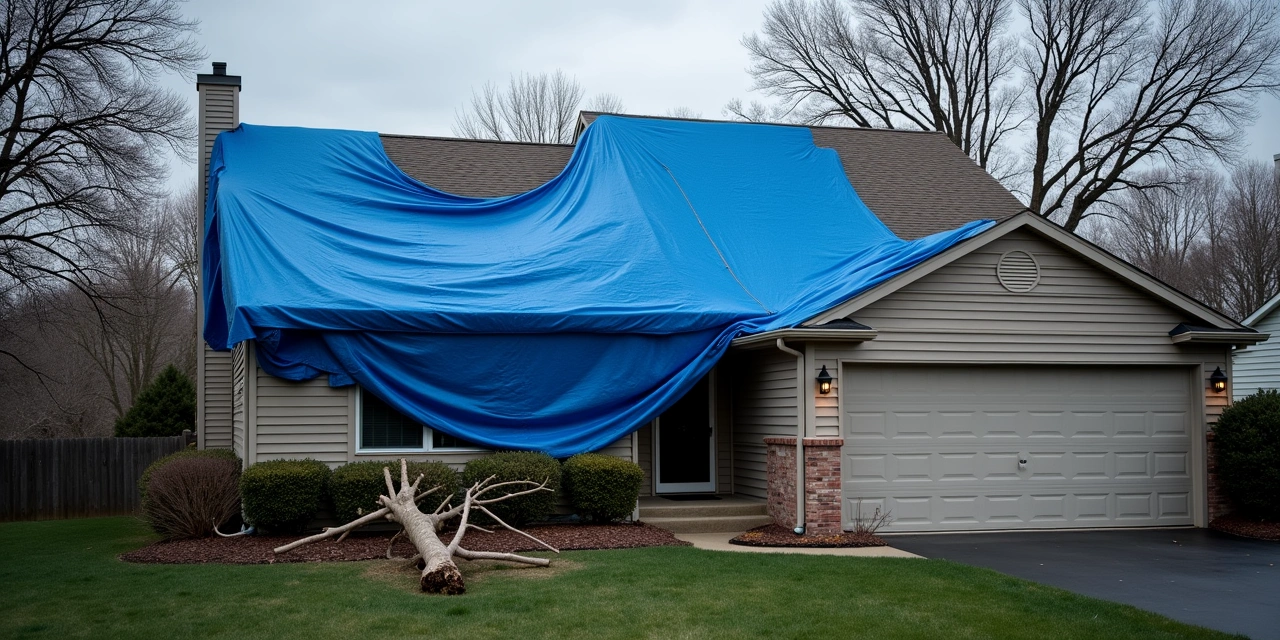
Quick answer: Emergency roof tarping is a temporary cover that keeps rain out of a damaged roof. A trained contractor installs it, not the homeowner. Fairfield Peak Roofing is a referral service. We pass your request to independent contractors in our network.
What emergency roof tarping is
Roof tarping means a contractor covers a damaged roof area with heavy plastic sheeting. The sheeting is fastened down so wind and rain stay out. It is a stopgap, not a repair.
It works like a bandage. The wound is still there. The tarp just keeps it from getting worse while you sort out the permanent fix.
Homeowners in Lancaster and Fairfield County search for roof tarping after storms and tree damage. This page covers what happens, what you can safely do and who to call.
When a roof needs a tarp
A tarp helps when the roof is open to weather and repair must wait. Common cases:
- Water is dripping or running into the house.
- A tree limb or a whole tree has hit the roof.
- Wind has torn off shingles and left bare decking.
- Hail or storm debris has made holes you can see from the ground.
- The permanent repair has to wait for an adjuster or for dry weather.
Not every leak needs a tarp. A slow stain after a hard rain may need a roof leak repair visit instead. A contractor can tell you which. For urgent work, see our page on emergency roof repair.
What a tarp does and does not do
A tarp has one job. It keeps water out for a short time. That matters, because water that reaches insulation, drywall and floors adds to the damage.
A tarp can
- Keep rain out of the opening for a short time.
- Limit damage to ceilings, insulation and floors.
- Buy time for an adjuster visit and a permanent repair.
A tarp cannot
- Fix broken shingles, flashing or decking.
- Make the roof safe to walk on.
- Last forever. Ask the contractor how long to expect it to hold.
A tarp also doesn't replace an inspection. Once the weather clears, a roof inspection shows what the storm really did.
Active leak: what to do and in what order
Water coming through a ceiling is stressful. A set order of steps helps. Every step below happens on the ground or inside the house.
- Stay off the roof. Look from the ground only. The next section explains why.
- Protect belongings. Move furniture and electronics away from drips. Set out a bucket and lay towels around it.
- Photograph the damage. Shoot every damaged area inside and outside. Note the date and time.
- Call your insurer. Have your policy number ready. Start the claim before repairs begin.
- Request a contractor tarp. Use the button below or call 877-367-1885. We forward your request to independent contractors.
- Keep every receipt. Save paperwork for emergency supplies, temporary repairs and any professional services.
Call 911 if you see downed power lines, smell gas or fear a collapse. Treat any downed or overhead line as live.
Why you should stay off the roof
Falls from roofs cause serious injuries, and a storm-damaged roof is worse. A tree strike or wind damage can weaken the structure under the shingles. You can't see that from on top.
- A damaged roof may not hold your weight until someone confirms its strength.
- A tarped roof is very slippery, especially when wet.
- A tarped skylight is hard to see and easy to step through.
- Power lines near the house may be live.
That is why this page has no do-it-yourself tarp steps. The safe version of the job needs trained crews and proper equipment. Your part is to stay on the ground, stay dry and gather proof.
Document the damage for insurance
Photos are your best record. Take them before anything is cleaned up or covered. The City of Columbus advises photos and video of every damaged area, inside and outside. Keep damaged items until your insurer approves throwing them out.
Ask the contractor to photograph the roof before and after the tarp goes on. Keep the invoice. The North Carolina insurance department advises temporary repairs and saved receipts. It says reasonable protective expenses are part of the loss. It also says to wait on permanent repairs until your insurer inspects. That is another state's advice. We could not open an Ohio Department of Insurance page on tarps. Your policy and the cause of loss decide. Read up on your deductible and insurance claim terms first.
Ohio claim clock: what to do at each step
Ohio sets insurer clocks in Ohio Adm. Code 3901-1-54. The table maps each clock to an action.
| When | What the rule says | What you do |
|---|---|---|
| Day 0: you give notice | The clocks have not started yet. | Photograph from the ground. Call your insurer. Request a tarp. Start a receipt folder. |
| By day 15 after notice | The insurer "shall acknowledge the receipt of a claim within fifteen days." Paying or sending claim forms also counts (paragraph F(2)). | Note the date you called and the name you spoke with. No reply by day 15? Follow up in writing. |
| After you send proof of loss | The insurer must decide to accept or deny "within twenty-one days" of properly executed proof. If it needs more time, it must tell you why (paragraph G(1)). | Send complete proof and keep a copy. Mark day 21 on a calendar. Ask in writing why if it runs late. |
| After acceptance | The insurer must pay "no later than ten days after acceptance of a claim" when the amount is not in dispute (paragraph G(6)). | Track the acceptance date. Follow up in writing if payment is late. Use the invoice and receipts. |
| Not set by this rule | Your own deadline to report a loss. | Read your policy. Call early. |
We checked the rule text on October 23, 2026. Read the full text before you rely on it.
These clocks bind the insurer. They don't set your deadline. Policies often have their own reporting deadlines, so call early. Read our guides to the claim timeline and how to file a claim. An insurance adjuster may visit before permanent work starts.
What a professional tarp job involves
These steps come from a shingle maker's tarp guide. The IKO tarp guide sizes the tarp to run a few feet past the damage. The crew photographs the damage first. They clear loose shingles and nails.
- Securing method: The crew wraps the tarp end around a thin board. Boards are angled so water drains off. Nails or screws go through the boards into the shingles.
- Side effect: Those shingles will need replacing during the permanent repair.
- Adhesive tarps: They avoid nails. IKO calls them less secure and says to check them regularly.
- Vents and chimneys: IKO says never cover a plumbing vent or chimney with a tarp. Roofers cut an opening and tape the tarp to it.
- Crew size: IKO says to unroll the tarp with at least two people.
How long a tarp can stay on
IKO says a tarp can stay while it is intact and dry underneath. Repairs should happen soon. It gives no day count, and we found no sourced one. Ask your contractor how long to expect it to hold. If the tarp tears or leaks, call the crew that installed it.
Why crews, not homeowners
IKO states: "Homeowners should not attempt to place a tarp by themselves." Federal rules also protect workers at height. 29 CFR 1926.501 requires guardrails, safety nets or fall arrest systems. That applies to residential work 6 feet or more up. Ask the contractor how the crew will be protected. We list no tarp prices because no source we opened states them.
How a tarp referral works
We don't tarp roofs. Fairfield Peak Roofing is a lead-generation service. You send a request. We forward it to independent, licensed contractors in our referral network. They contact you.
Those contractors set their own prices, availability and terms. We can't guarantee who arrives, how fast or at what price. Before you agree to anything:
- Get the price and scope in writing before work starts.
- Ask for a certificate of insurance.
- Compare more than one estimate when you can.
- Don't pay in full up front. A deposit is normal, full payment is not.
- Be wary of door-to-door offers after a storm.
- Check Ohio Secretary of State registration. Ask the building department what permits apply.
- Walk away from anyone who offers to waive your deductible. Ask your insurer and the Ohio Department of Insurance first.
We found no general statewide residential roofing license in Ohio. Some cities and counties require local registration or permits. Verify current rules yourself. See our guide to choosing a roofing contractor in Ohio.
Check Availability Call 877-367-1885
Roof tarping in Lancaster and Fairfield County
We take requests from Lancaster and nearby towns such as Pickerington, Canal Winchester, Baltimore, Millersport and Thornville. See all service areas.
Wind and falling limbs are common causes here. Our emergency roof repair guide and storm damage page cover related steps. Terms like storm damage are defined in our glossary.
Roof tarping FAQ
What is emergency roof tarping?
Emergency roof tarping is a temporary cover over a damaged roof. A contractor fastens heavy plastic sheeting over the opening to keep rain out. It is a stopgap until a permanent repair can be done.
Can I tarp my own roof?
We don't recommend it. A damaged roof may not hold your weight, and a wet tarp is very slippery. Stay on the ground and ask a contractor to do it.
How much does roof tarping cost?
Contractors set their own prices, so we can't quote one. Ask for the price in writing before any work starts. Compare more than one estimate if you can.
Does insurance pay for a roof tarp?
Often, but your policy decides. The North Carolina Department of Insurance says reasonable protective expenses are part of the loss. Keep every receipt and photo.
How long can a tarp stay on the roof?
A tarp can stay while it is intact and dry underneath, says IKO. Repairs should follow soon. We found no sourced day count, so ask your contractor.
How fast can a contractor arrive?
We can't promise a response time. Contractors are independent and set their own availability. Demand rises after storms, so call as soon as you have photos.
Do I call my insurer or a roofer first?
You can do both on the same day. Take photos from the ground first. Then call your insurer to start the claim and request a contractor.
How this page was researched
We read the Ohio claim rule, city and state storm guidance, a manufacturer tarp guide and a federal safety rule. Last reviewed October 23, 2026. OSHA and Ohio Department of Insurance pages would not open for us. We left out tarp prices, day counts and response times. We could not verify them. Sources:
- Ohio Adm. Code 3901-1-54, Unfair property/casualty claims settlement practices
- City of Columbus, Property Damage guidance (Extreme Weather, August 2026)
- North Carolina Department of Insurance, After a storm (another state, regulator guidance)
- IKO, How to install a roof tarp (shingle manufacturer)
- 29 CFR 1926.501, Duty to have fall protection (Cornell LII copy)
About this page: Fairfield Peak Roofing wrote it as a referral service, not a roofer. Learn more about us and read the full disclaimer. No contractor, adjuster or attorney has reviewed this page.
Disclosure: This site is a lead generation service. It connects Ohio homeowners with independent, licensed roofing contractors. We are not a roofing contractor and hold no Ohio roofing license. We do not perform roofing work. Contractors set their own pricing, availability and terms. See our full disclaimer.